


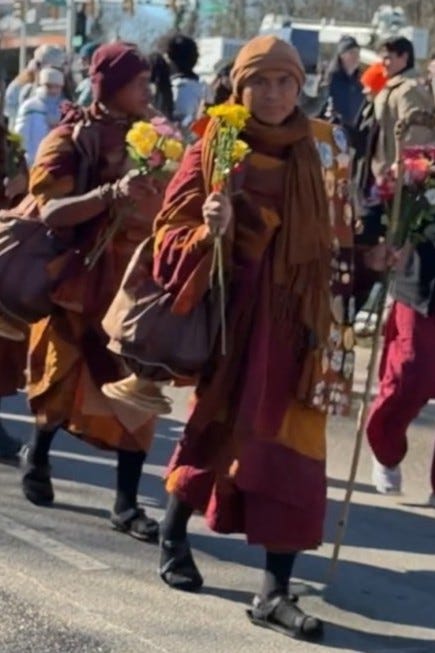
Buddhist monks walked for peace through Richmond’s Southside and onto the downtown streets last week. They crossed the Manchester Bridge over the James River, gathered briefly at City Hall, and continued on to Virginia Union University, one of the nation’s 107 Historically Black Colleges and Universities, where they’d spend the night. They did so with a calm dignity that reframed what public life can feel like when the guiding principle is peace rather than protest.
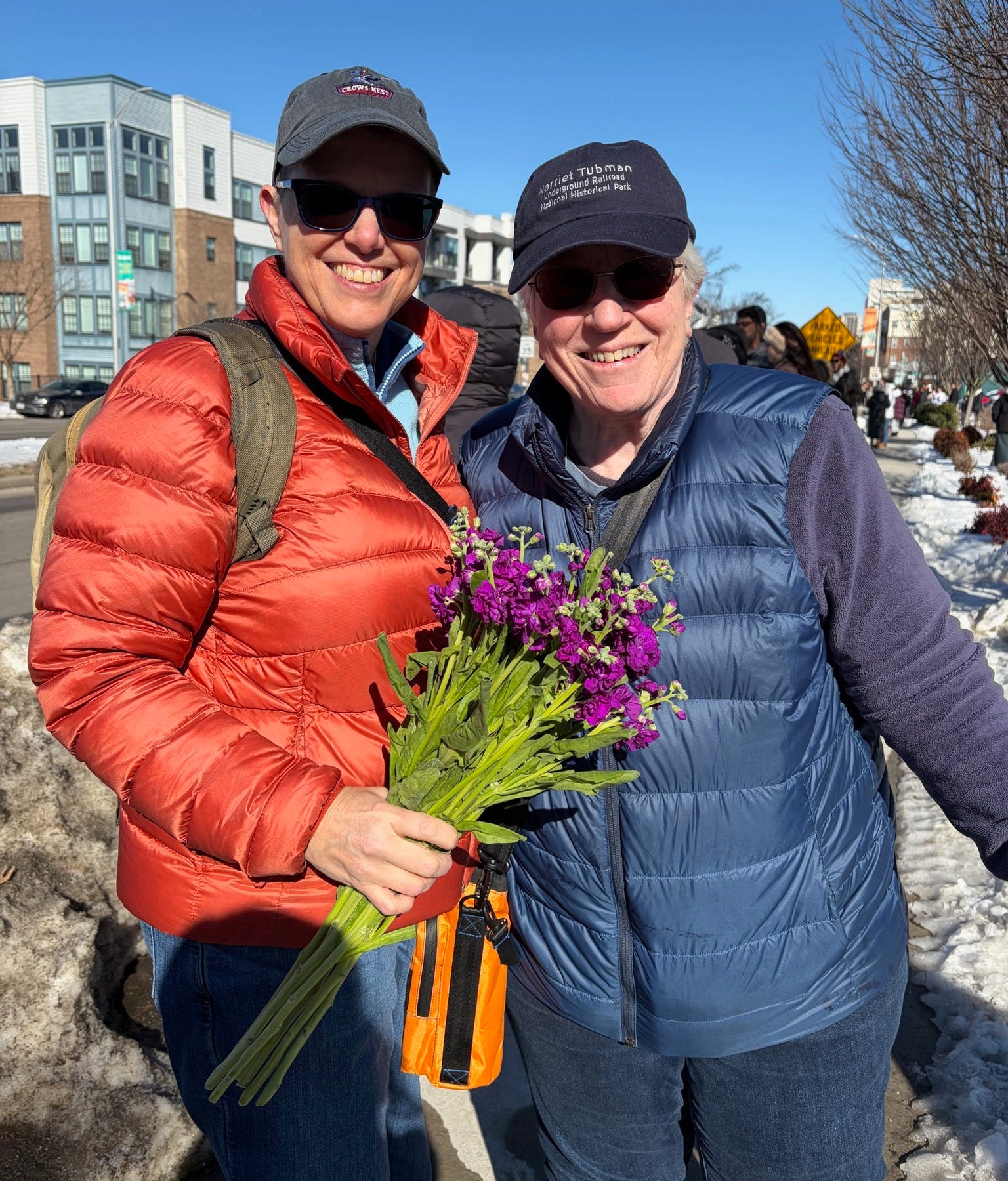
Wendy and I joined them for part of that walk and met them again later that evening for a second, quieter encounter. The day unfolded as a kind of collective pause—not born of conflict or agitation, but shaped by intention, presence, and open-hearted attention. Peace in motion.
The walk is led by Venerable Bhikkhu Paññākāra, a senior Buddhist monastic whose vision for this pilgrimage goes well beyond symbolism. His leadership is grounded in the belief that peace is not merely an abstract ideal but a lived practice, one made visible through discipline and repetition. The nineteen monks embodied that conviction simply by walking, day after day, through towns and cities much like ours.
From the beginning, Venerable Paññākāra has encouraged the people they meet along the way to adopt a daily practice that centers peace in ordinary life. One of the simplest and most foundational instructions he offers is this: each morning, write the words “Today will be my peaceful day.” This exercise is not rhetorical. The writing itself—the movement of the hand, the shaping of the words, the intention behind them—invites mindfulness, compassion, and equanimity into the day ahead.
Walking with Intent
What distinguishes this pilgrimage from other public gatherings is not the length of the route—approximately 2,300 miles from Fort Worth, Texas, to Washington, D.C.—nor the number of days the monks have walked (108), but the quality of attention they bring to each step and ask others to bring to their own lives.
Walking is the medium of the message. According to the mission and vision of the Walk for Peace, this simple, universal act was chosen because walking transcends borders, cultures, religions, and ideologies. It symbolizes humility, equality, and shared humanity. Each step affirms nonviolence, compassion in motion, mindfulness, and responsibility for the world we share. Participants are invited not to debate peace, but to embody it.
Venerable Paññākāra has said that the walk itself does not create peace. Only the people they meet along the way can do that by choosing peace in their own hearts and actions.
The core values of the walk reflect this understanding: nonviolence in thought, word, and deed; compassion expressed through action; unity without requiring uniformity; mindful presence; and responsibility for one another, the environment, and future generations. Walking for peace is, at its heart, about turning intention into action.
A Different Kind of March
Richmond is no stranger to public demonstrations. In the past year alone, the city has hosted multiple No Kings and anti-ICE marches, many carrying legitimate demands for justice, free speech, humane treatment of immigrants, and other pressing concerns. I have participated in those marches. I have felt their urgency, their anger, and, at times, their desperation.
Although there was camaraderie among participants, the energy was often oppositional—focused on what we were resisting or demanding. Even when signs espousing violence toward the President or other leaders made me cringe, they did not stop me from leading chants of “No Justice, No Peace” as we marched in opposition to the current federal administration.
The Walk for Peace through Richmond was different. Not detached from reality but attuned to possibility. Walking with the monks felt like an invitation to notice something beyond reaction—to pay attention to what emerges when the posture is not resistance, but presence. I liked what that experience stirred in me.
Richmond’s Response
As Wendy and I walked with the procession from Manchester toward City Hall, the tone was unmistakable. There were no megaphones, no shouted demands, no sharp rhetoric. Instead, there were steady footsteps, quiet conversations, and genuine curiosity from people lining the sidewalks.
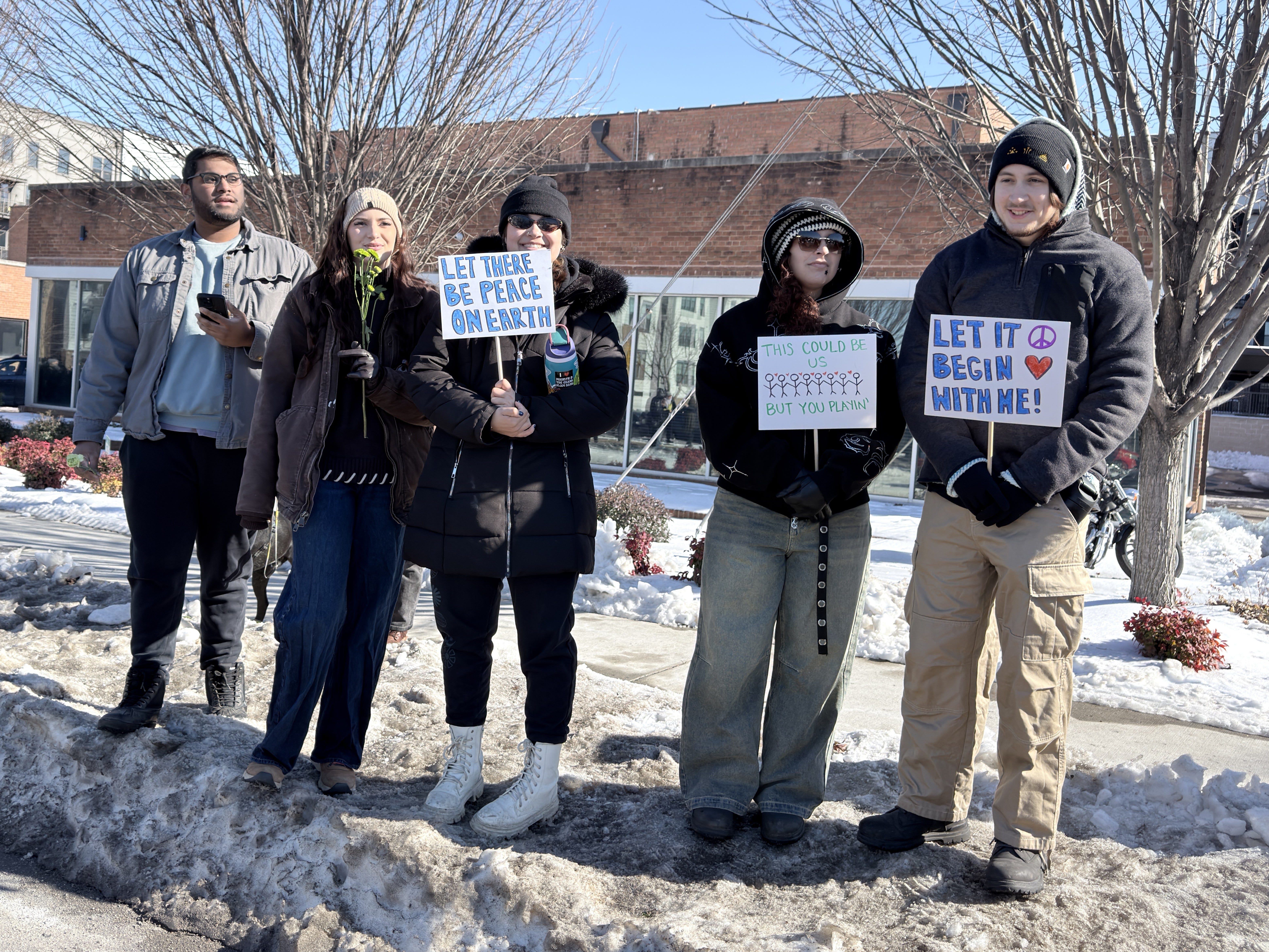
While waiting near a fire station where the monks had stopped for lunch, I struck up a conversation with five young adults standing nearby. They told me they were close friends—had been friends since middle school—and members of the same Unity church. They had come because they wanted to experience the feeling of peace the monks carried with them. They had participated in other marches, they said, but this one felt different. They were glad they were there.
I remember thinking what a gift it was for a group of young adults to experience peace not as an idea, but as a shared, embodied moment—perhaps in a way they hadn’t before.
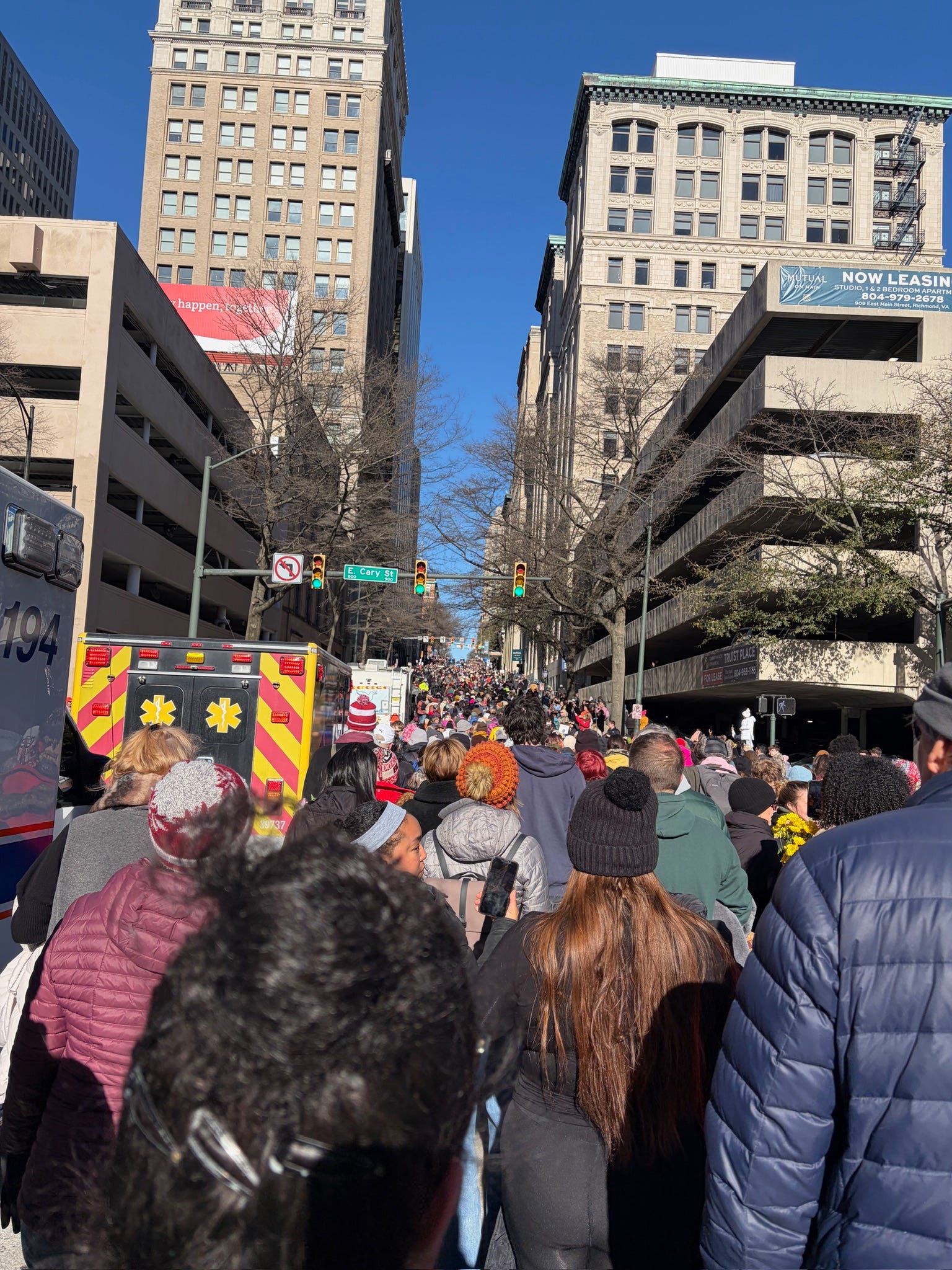
As the walk continued downtown, people didn’t brace for confrontation, as is often the case at protests. They didn’t yell or jeer. They simply opened space in their routines to witness what was happening when peace became the public language. One participant held a sign that read, “We need this.” I couldn’t have agreed more.
The crowd grew as the monks approached City Hall. Estimates put the number of people who came out to witness the walk in the thousands. Local coverage described cheering, clapping, tears, and flowers offered along the route. Even Richmond police officers handed blossoms to the monks as they passed.
City leaders welcomed the monks at City Hall. Mayor Danny Avula and Governor Abigail Spanberger both spoke briefly, acknowledging the significance of the moment. Governor Spanberger issued the first gubernatorial proclamation of her administration, declaring it Walk for Peace Day in the Commonwealth of Virginia.
That proclamation framed the walk not as a fleeting event or political statement, but as an invitation—to practice peace intentionally and publicly, even in a time of fragmentation. As the Governor observed, “Peace is a daily practice that begins within and radiates outward to families, communities, and nations.”
Presence on Lombardy Street
Later that afternoon, Wendy and I crossed the city ahead of the monks so she could photograph them in front of the school where she works as librarian. When we met them again on Lombardy Street, the mood was quieter but no less intentional. Familiar faces, including some of Wendy’s coworkers, had gathered. People spoke softly, gestured kindly, and paused as the procession passed.
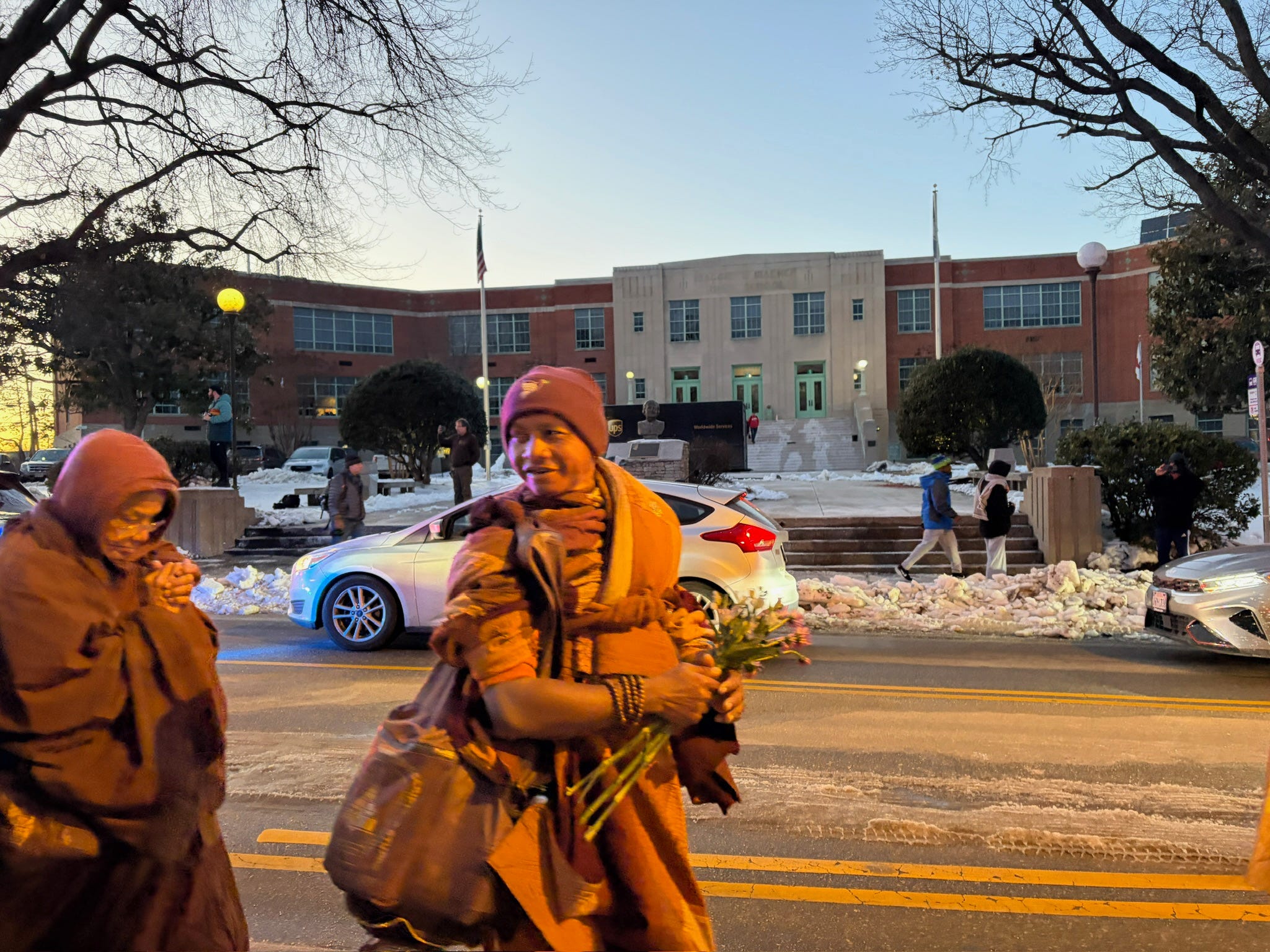
There was no momentum toward conflict—only toward calm. Strangers exchanged small, neighborly greetings. It was a form of togetherness that didn’t require agreement on any issue, only a shared willingness to be present and peaceful. In a season when public life so often fractures along hard lines, that felt remarkable.
Walking the Talk
This walk was not a momentary diversion. Its values echo through every community it touches. By emphasizing nonviolence, compassion, unity, and mindful presence, the monks invite people of all backgrounds to consider peace not as a slogan, but as a way of living. Their intention is not to convert anyone to a particular faith or ideology, but to remind us that peace begins within each person and radiates outward.
As we walked that afternoon, I kept returning to Venerable Paññākāra’s daily practice: “Today will be my peaceful day.” The instruction is disarmingly simple. Yet it carries weight. It reminds us that peace is a choice we make as the day unfolds, not something that appears only after conflict has been resolved.
Peace took to the streets of Richmond on February 2. It arrived on foot, without demand or decree. It moved at a steady pace, teaching what it means to show up, to witness, and to let presence become a public posture. Now that the monks have reached our nation’s capital for their final two days of events, I find myself wondering how this experience might shape the way I show up in the future.
The Walk for Peace has caused me to rethink the energy I bring—and encourage others to bring—to public demonstrations. I’m curious to discover where this reflection leads as I suit up for the next protest march.
Could that, too, be a walk for peace?
For more about the monks, their journey, and their vision of peace, visit Walk For Peace.
Yours in peace,
Annette

You made me feel like I was there with all of you, feeling that quiet strength and peaceful motion. So beautiful, Annette, thank you for sharing this.
177204. Thank you for this piece Annette. It caused me siting alone to sing Enter, Rejoice and Come In.