


Earlier this month, I went to prison. Not jail, but prison. Fluvanna Correctional Center for Women (FCCW) to be precise. I went as a believer in human dignity. What I didn’t expect was how hard that belief would be to hold onto by the time I headed home.
Fluvanna is a medium to high security women’s prison, which houses 1,200 residents, located about an hour from my home in Richmond, Virginia. I went there, not as a resident, I’m happy to say, but as a guest of Proximity for Justice.
Proximity for Justice is a 501(c)(3) non-profit organization that believes:
To build safer communities, we must first open prison doors to allow the outside world to meet those most affected by incarceration.
That’s what took me into prison—to attend a TEDx event organized by Proximity for Justice. They had invited 100 community members, including regional leaders from Charlottesville, Richmond, and Washington, DC, policymakers, judges, attorneys, law enforcement and corrections officials, fair-chance employers and local business leaders, community advocates, philanthropists, and TED members to listen to speeches by 30 residents of FCCW interspersed with 15 by community and criminal justice system professionals.
The Experience
We were asked to arrive early—before 8 am. I was nervous about what we were about to experience and having to drive an hour at a time when my brain is typically still in a fog, was not my idea of a good time. I was relieved, however, that our preapproval meant we glided through the entry process. We were told not to wear jeans because that's what the residents would be wearing. I was happy I remembered that, so there’d be no confusion.
We were also told that all we could bring in to the prison was our driver’s license, which they kept for us when we checked in, and one car key. No phones, watches, or other electronics. Not even a pen or paper. Deprived of my devices, I felt almost as naked as I would have if they’d strip-searched me. That’s an exaggeration, but it reminded me of how dependent I am on being able to record, take notes, check messages, and know what’s happening in the world. Without them, all I could do was listen, which I guess was part of the point.
A few minutes after entering the gymnasium where the event was being held, the staff led the prison residents in. We learned through subsequent conversations with several of the residents that they had been told only that morning that they’d be allowed to interact with the guests, shake our hands, and sit with us throughout the event. That, in and of itself, was earth-shattering to some. Many of the women receive no regular visitors, and for those who do, the visits are often fraught with tension and dis-ease. For some, we were the first outsiders, except for prison staff, they had interacted with in years. One woman told me she couldn’t get over seeing all the clothes. Seeing people dressed up in professional or even casual attire beyond jeans and t-shirts captivated her.
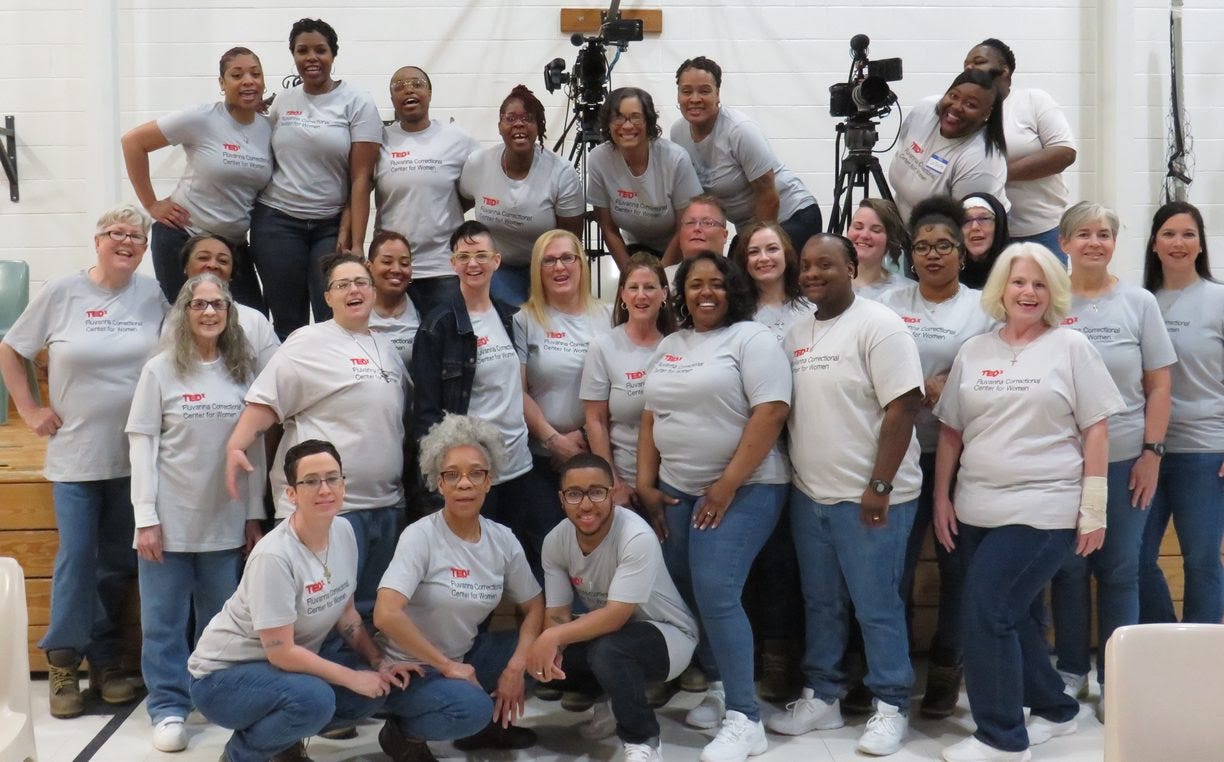
I could tell from the bright smiles and friendly hellos that for most women, whether they were speakers or guests of speakers (each resident who spoke was allowed to invite one other resident to support her), they loved interacting with us. Some were, of course, shyer than others. While some, like the woman serving multiple life sentences for murdering her husband over twenty-five years ago, relished in the attention.
The Women and their Stories
By the time the talks began, I’d already learned that the residents had been preparing for this day for over a year. They applied almost eighteen months earlier, went through a selection process, and once chosen, were then coached on their five-to-10-minute speech. Or perhaps I should say, “performance.” In addition to standard speeches, we heard rap performances, spoken word poetry, a violin concerto, and songs.
Some women talked about the crime that got them there, like Ashleigh who, at age 17, described how she fell victim to a controlling boyfriend who encouraged her to kill her mother because she didn’t like them being together. “I’m my own person now,” she said. She no longer feels led by others. In prison, she learned who she is and how to stand up for herself.
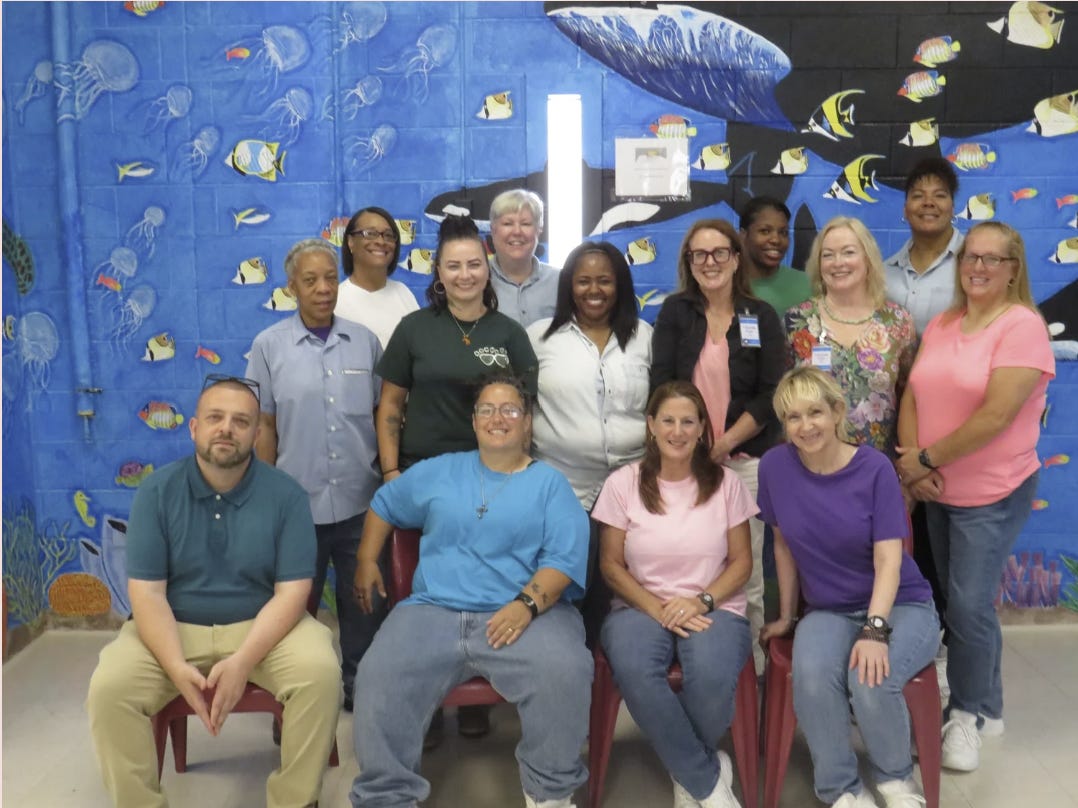
Others talked about life in prison, like Kelley, who goes by “Turtle.” She shared a poetic speech about memories she’d created in many of the rooms of the prison. She shared how her daughter’s Girl Scout troop had come to the room we were in, the gymnasium, and how that allowed her to witness her daughter growing up. She described some of the many murals she’d been allowed the paint around the prison and how much it meant to her that little kids visiting their parent loved the “fishies” she painted on the visiting room wall.
Some talked about their involvement in recovery programs in prison, how they’d earned their GED or associate’s degree, or in some cases, even a masters. One became a certified optician and hopes to become licensed and open her own practice when she’s released.
Several talked about dog training. Women who participate in the dog training program at FCCW are taught how to train the dogs and the dogs, in turn, offer the trainers solace and companionship (the dogs even sleep in the women’s cells with them), in addition to teaching them about discipline and responsibility, something that many of the women hadn’t learned in their lives outside. For some women, the dog program is a life saver. One resident shared how she wants to become a professional dog trainer when she’s finally able to leave prison behind her.
Virginia abolished parole in 1995, so none of the women incarcerated after that are eligible for parole. They might receive 15% off their sentences for good behavior, but that is moot for someone with multiple life sentences. One woman, Jean, was 64 years old when she shot and killed her husband twenty years earlier while he sat in their living room. She said she’s being released in three years after serving a total of twenty-three of the twenty-eight-year sentence.
Senior citizens can apply for geriatric release if they are age 60+ with 10+ years served or 65+ with 5+ years served, which essentially means the Department of Corrections no longer has to pay for their care as they age in place. I don’t know on what basis Jean is being released, but she’s told us that she’s looking forward to spending time with her grand and great-grandchildren and learning how to use a smart phone.
At the other end of the spectrum, juvenile offenders tried as adults might also be considered for parole. Women who were juveniles when they were arrested were plentiful in the room with us that day. When I commented to one older woman about how moved I was by the presentations I’d heard so far, she said, “What till you hear the young ones. They’re coming up next.”
Sure enough. The “young ones”—one woman who was only thirteen when she committed the crime that got her there—spoke about what it was like to grow up in prison. Not surprisingly, we heard that many of their lives before prison included child sexual abuse, intimate partner violence (IPV), addiction, broken homes, gangs, mental illness, prostitution, and foster care. Some, if not all of these young women, never had a chance.
Sadly, prison life has provided them with more stability than they’d previously experienced. I don’t know what life on the other side will be like for those who get there. Getting out isn’t guaranteed. Less than 5% of people of all ages who apply for parole in Virginia each year receive it, so many of these women will live a good part, if not all, of the rest of their lives inside the walls of FCCW.
As I listened to the women’s stories, I was struck by how well each and every one of them presented. There was not a single “um” all day. I was also impressed with how confidently they engaged with the guests who had come to hear them. For people who have such limited interactions with strangers that was particularly remarkable.
Feeling Unsettled by their Crimes
As the day went on, there was something unnerving happening inside of me that I couldn’t put my finger on—something deeper in their stories and in my response to them. As I’ve reflected on it, I realized that it had to do with how sincerely I believe in people’s ability to change. After twenty years working in the addictions recovery field, I thought I could trust my honesty detector. I’ve listened to alcoholics who claimed to be sober only to discover they’d starting drinking again and addicts who insisted they were clean even when a drug test proved otherwise. Those experiences taught me to listen more to how something is being said than to the words being spoken.
After hearing so many wrenching stories, I found myself questioning which of these women had, in truth, turned their lives around. Could I trust what they said about who they had become in prison and that, if released, they would live crime-free lives?
My Unitarian Universalist faith calls me to affirm the inherent worth and dignity of every person. I’ve tried to live into that, even when confronted with a person whose actions are contemptible. But can I do it? Do I truly believe in every person’s inherent worth? Do I believe that someone who can do a despicable thing, like so many of these women have done, can change? Do I believe Bryan Stevenson, the founder of the Equal Justice Institute, who says that “each of us is more than the worst thing we’ve ever done?”
I realized how unsettled I was with these questions when I returned home and spent the next day researching what got each of these women into prison in the first place. I read one tale of a women, Erin, now a published writer and award-winning poet who has already served 25 years of a life-without-parole (LWOP) sentence for killing her husband, ostensibly for his life insurance. I read about how another woman doused her husband in gasoline and set him on fire. Three of the speakers were part of a group of four who beat and killed a teenage friend of theirs just a few miles from my house. One participated in a drive-by shooting. Another in a gang-related shooting. A licensed attorney took hostage the managing partner of the law firm that had fired her, tortured him and his wife in their own home, and killed them both. In another crime against a former employer, a woman murdered a family of four who owned a restaurant from which she’d been fired. Another killed her thirteen-year-old special needs adopted daughter after abusing her for years. Two more killed children in their care. And the stories go on.
I stepped away from my computer feeling nauseous and uneasy. This is not what I thought I would learn. I found myself troubled by my own assumptions. I expected to discover that most of the women were acting in self-defense as victims of intimate partner violence (IPV). After all, isn’t response to abuse the primary reason women are driven to kill? I didn’t expect the viciousness with which many of these women attacked their victims.
At first glance, the White women seemed to have committed calculated crimes of passion, while the women of color were more prone to have been involved in other crimes that resulted in death. Were these my own biases creeping in or was this an indication of the role race plays in convictions and sentencing?
I sat with my wife and discussed my findings with her. She shared my surprise that many of the murders appeared premeditated, rather than the result of rage in the moment, as might be the case in response to abuse. We struggled with the tension between the victims’ suffering, their family’s losses, and the perpetrators’ inherent worth and dignity.
I decided that, before I could answer my question about whether I agreed with Bryan Stevenson, I needed to understand what the research actually shows about race and sentencing. This is what I found.
Research about the Role of Race
Research conducted by The Sentencing Project and the National Black Women’s Justice Project documents that the women incarcerated in state prisons don’t arrive there in equal numbers or under equal circumstances. Nationally, Black women are 50% more likely than White women to receive a LWOP sentence, and in states that have been willing to share their data, Black women represent more than half of all women serving life sentences.
Virginia locks up Black residents at 4.1 times the rate of White residents, and Black inmates are nearly twice as likely as White inmates to carry mandatory minimum sentence—the kind that eliminate judicial discretion and foreclose any possibility of mercy. Virginia didn’t share its gender- and race-disaggregated life without parole data with these national researchers, which means the full picture remains deliberately obscured.
According to the Prison Policy Initiative, Virginia’s incarceration rate of 115 women per 100,000 residents means that it incarcerates women at a higher rate than nearly every other country on the planet. Canada, for example, incarcerates women at a rate of only 15 per 100,000. The women bearing the heaviest weight of that distinction in the U.S. are disproportionately Black.
The results of my research raised another question entirely. Maybe the savagery I uncovered in the White women’s stories wasn’t a coincidence. Maybe it was a threshold.
Anything less than these gruesome crimes and the White women might have pleaded down, claimed self-defense, or walked. By virtue of their race and economic circumstances they could hire attorneys, rather than rely on overworked court-appointed ones. Those attorneys could present the perpetrators more sympathetically to juries who might feel less inclined to convict a White woman in the first place.
Women of color seldom have these options. Implicit racial bias sees them as guilty before they even present their case. Without, in many cases, the money to afford a good attorney or a quality education to help them know what they’re facing, BIPOC (Black, indigenous, people of color) women are less likely to succeed in court. At least four of the BIPOC women who gave TEDx talks were convicted of felony murder, where a death occurs during the commission of another felony, allowing a murder conviction without proving intent to kill. None of the White women received a felony murder conviction. What does this say about our justice system?
The ACLU of Louisiana reports that of 3,278 prisoners serving LWOP for nonviolent offenses, 79% were convicted of nonviolent, drug-related crimes such as possession or distribution, and 20% of nonviolent property crimes like theft. And in that nonviolent LWOP population, 65% are Black, 18% are White, and 16% are Latino.
This data did not surprise me. I’d studied it before. But the research took on new meaning when I applied to women I’d actually met in person. It caused me to question whether some of the BIPOC TEDx speakers deserved the harsh sentences they received, and whether White women are wandering the streets after getting away with their crimes. This is a scary prospect in both cases.
What this Day Taught Me
This day taught me more than I expected about myself and my prejudices. I’m grateful for that. The experience of meeting, hearing from, and reading about these women will stay with me for a long time. They’ve given me much to think about.
Each of us is more than the worst thing we’ve ever done.
Bryan Stevenson
When I first posed the question about whether I believe Stevenson’s adage, I wasn’t sure of the answer. I’m still not. Do I believe that these women—the ones who set their husbands on fire, the ones who killed children, the ones who tortured and killed their employers—are more than the worst thing they've done? I don’t know. Do I believe in their inherent worth? I don’t know that either. The best I can say is that it’s complicated.
I do, however, believe that all women deserve a chance. Some of these women were caught in circumstances they didn’t have the resources, skills, or abilities to get out of it in any other way. Prison has strengthened them and given them the opportunity to be different people.
That’s why I firmly believe many women should have the right to prove themselves to a caring parole board. The 30 women who delivered flawless and impactful TEDx talks at this event are evidence of that. They’ve worked incredibly hard to get to this place and, whether or not I trust fully in their rehabilitation, I believe that, at the very least, they deserve to have a glimmer of hope in their lives—something to work toward.
I strongly support the return of parole to Virginia. This is only one step in reforming the justice system to ensure that all people are treated equally and fairly without discrimination. The women I met in FCCW deserve this. And I’m sure that many of the other 1,200 women incarcerated there and around the state deserve it, too.
Whether you share Bryan Stevenson's conviction or, like me, are still wrestling with it, what are you called to work on to support incarcerated people in your community? It’s a question these women deserve an answer to.
If you’d like to watch news coverage of the event, visit: CBS19 Charlottesville: TEDx At Fluvanna Correctional.
Yours in peace,
Annette

Thank you Annette. Such a provocative and complicated issue, and clearly without easy answers. But yes, the parole issue seems an important option in these situations. One of the aspects that might be important is how the women felt about their own ability to control their circumstances once they were out of prison. None of us have complete power, but within certain limitations, we exercise control over our lives. I wonder if they feel they have been given opportunities to practice that, to understand and live the stresses of that.
Annette, a powerful story that brought back to mind my relationship with Michael,who, when he was 15, killed his 12 year old sister. As you will remember, I visited him weekly (with a few exceptions) for 3.5 years while he was awaiting trial.
At times I saw before me a young, scared, white young boy. Younger emotionally than his age. At other times I realized I was sitting less than an arm’s length away from a murderer, in a cell away from anyone else’s line of sight. Often I questioned who he was, who I was. I could “discount” some of the feelings because of his youth, but not all of it. History of abuse (by family and others, but thankfully not family of origin) was one of the reasons. But still—there were many times I felt disquieted. It often took me the hour drive home to regain some sense of calm.
Not the same as your experience, but it was a chance to wrestle with the concept of inherent worth. Especially when challenged by the guards as to why he should receive the benefit of a weekly visit with a chaplain when there was no chaplain provided for the staff.
Anyway, if you want another listening or thought partner, I’m here. Bless you for the risks in loving you set before yourself.