


I started my Substack newsletter two and a half years ago. Since then, I’ve published 218 posts—an average of 1.6 per week. Some weeks I posted every day. Other weeks, not at all.
Which raises a question I’ve been sitting with for a while now: If I’m not writing regularly, am I still a writer?
Over those two and a half years, I serialized two memoirs on Substack, Accidental Mentors: Inspirational Stories of Women Who Shaped My Life by Just Being Themselves, and Living Into the Truth: A Daughter’s Journey of Discovery (which I’ve since published in print and e-book formats), and published one inspirational series: Thirty Days of Hope, one beloved (at least by me) short-story, “A Big Job for a Little Bear,” and a fair number of posts on other topics, including in my Wandering WordsWomen series.
All that being said, in the twenty-seven weeks since I officially retired from paid employment, I’ve published to Substack only once every three weeks on average—a far cry from my pre‑retirement pace.
There’s no question that this new freedom has pulled me away from my laptop. I’ve been on the road about a quarter of that time, including long trips to Alaska and Northern Michigan. I’ve taken a digital photography class, which taught me more about F-stops and ISO than I will ever master, but it was still fun. I’ve read almost twenty books (look for my 2025 Review of Books coming before the end of the year).
I’ve streamed TV shows, movies, and YouTube videos with abandon (purchasing YouTube Premium is the best investment in all of the streaming world, in my opinion), played video games, and struggled to complete the daily NYT word puzzles and weekly news quiz. I’ve attended plays and concerts, including the Richmond Folk Festival. I’ve participated in protests, called my legislators, and hosted election postcard parties. I taught a virtual class about self-publishing and moderated a writing panel on setting as character.
I’ve studied Spanish on Duolingo. I’ve gone out to lunch with friends. I’ve spent a little (probably far too little) time working in the garden. My wife and I decorated for the holidays (inside and out) and even decorated for Halloween—a first for us! And I’ve stepped up my cooking contributions to the household, preparing dinner three times per week (give or take), a task akin to extracting my own teeth with a pair of rusty pliers.
When I’ve spent time with my laptop, it’s often been consumed with learning the newly-free photo editing, drawing, and layout software, Affinity by Canva. It’s the hardest software I’ve pushed myself to learn in a long time and, for anyone who knows me, you know that’s saying a lot. It’s not because it’s badly designed software, but because it’s so powerful. Affinity feeds my budding interest in graphic design and, at the same time, supports my self-publishing and photography goals, so it’s worth it. But there is a lot to learn!
The question persists: Does all this mean I’m no longer a writer?
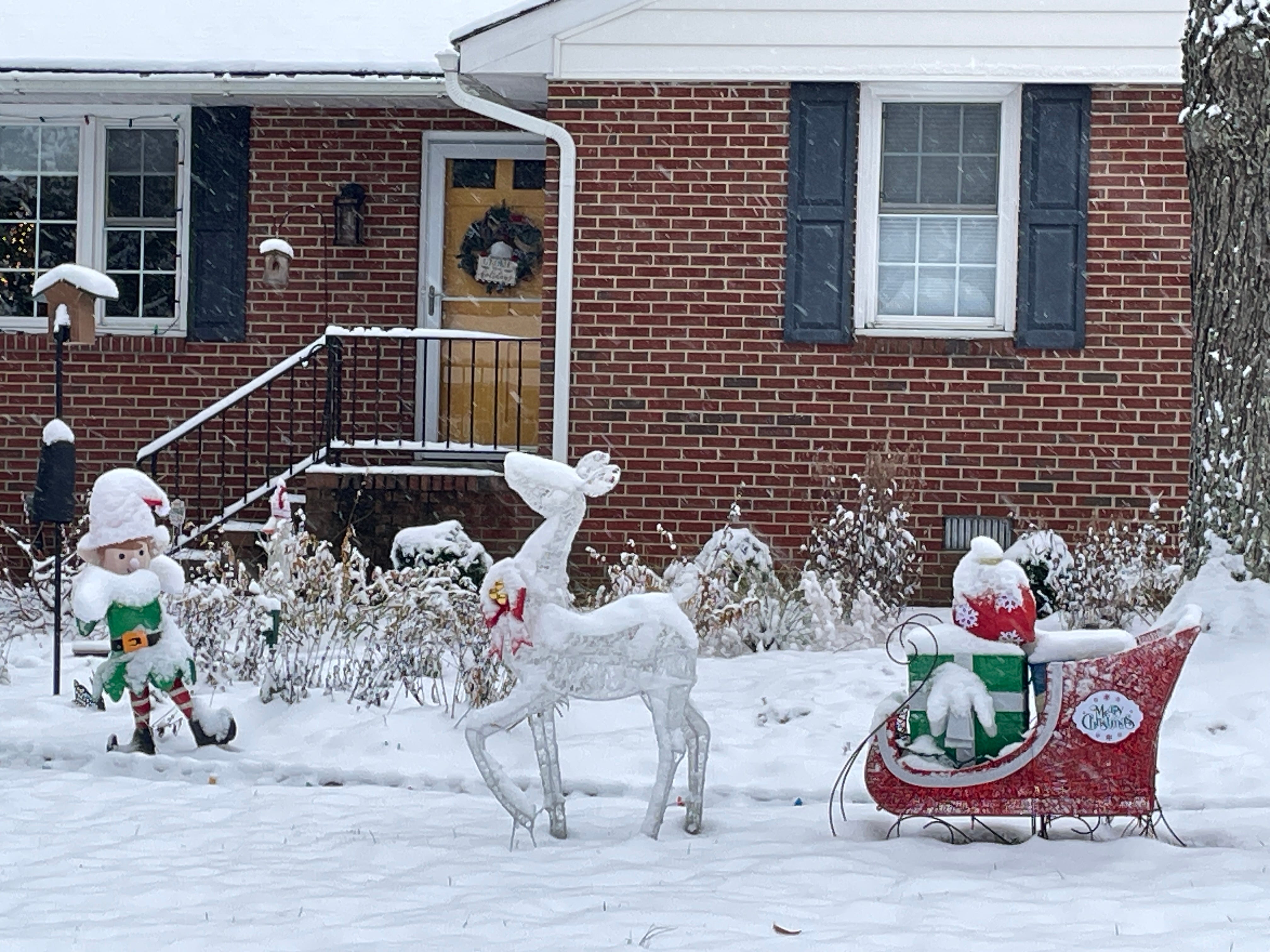
Is my commitment to writing, to engaging with my 500-plus Substack subscribers and to creating original work melting with the rare snow that blanketed my home in the Virginia Piedmont over this past week?
My answer is a clear and emphatic no!
To begin with, my social circle and volunteer activities are richer because they’re filled with writers. I love spending time with writers, reading about writers, and thinking about writing. Writing is not only something I do at a keyboard; it’s a way I move through the world.
I also firmly believe that writing and supporting writers is an act of resistance. Writers keep ideas and culture alive outside corporate and government interests. Writing strengthens people’s ability to think critically, question power, and imagine alternatives.
By supporting independent voices, we preserve truth, memory, and civic engagement in ways that those with wealth and power depend on suppressing. That’s why I include writing and building writers community on my list of ways I’m fighting against this increasingly authoritarian political climate.
Completing what I started
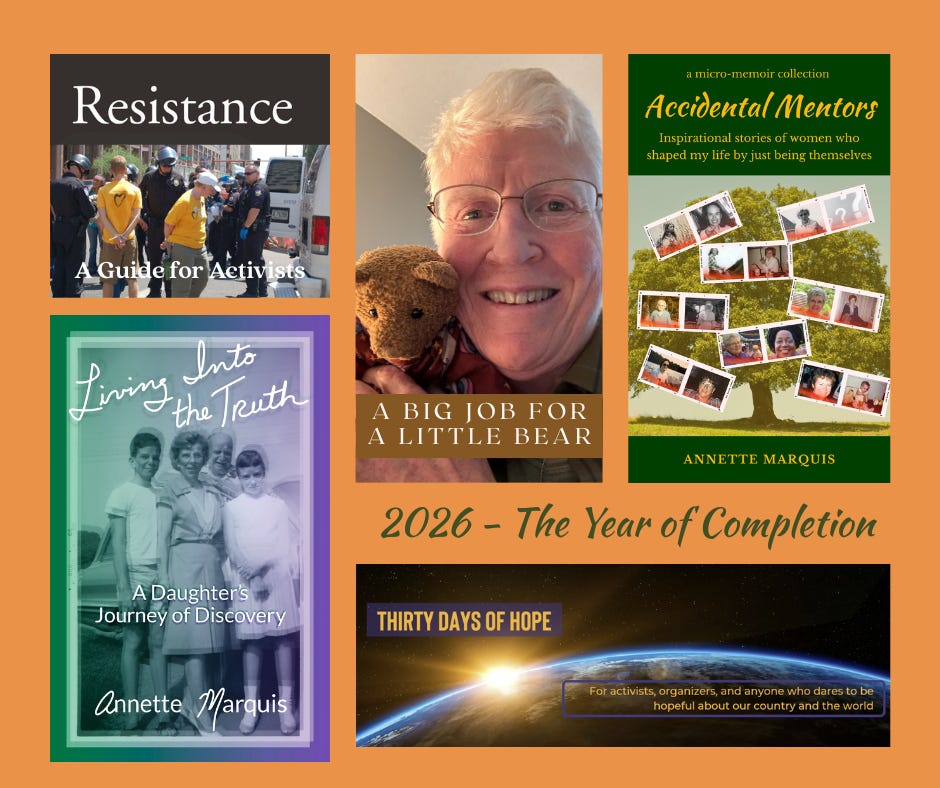
When people ask me what I’m doing in my retirement, I usually begin by listing the writing projects that hold prominent places in my plans. In fact, my wife Wendy and I have dubbed 2026 the “Year of Completion,” a year focused on completing writing projects we’ve started over the past few years. Here’s my list:
Publishing Accidental Mentors: Inspirational Stories of Women Who Shaped My Life by Just Being Themselves
Re-publishing my out-of-print title, Resistance, with new content about protest actions and other forms of resistance in the current political climate
Publishing the story of Earth Bear: A Big Job for a Little Bear
Publishing a Thirty Days of Hope inspirational book
Offering one or two virtual seminars on the process of self-publishing
In addition to my own projects, I’ve promised to help Wendy design and prepare a poetry manuscript of hers for publication.
It’s an ambitious list, but most of the content for all these projects is already drafted. However, they all need editing, revising, expanding, permissions, layout, photo editing, cover designs, promotion, etc. These tasks are different from creating brand‑new content, but they are very much part of the writing life.
I still worry if my paid Substack subscribers are getting what they paid for
About 10% of my Substack subscribers have chosen to be paid subscribers, a gift for which I’m profoundly, and humbly, grateful.
Still, during this slower posting period, I’ve wrestled with questions of value. I’ve felt pressure to produce, as if subscribers might be calculating the cost per newsletter to decide whether their investment is worthwhile. In a time of rising prices, growing layoffs, and other fiscal challenges, I get it.
But writing this post clarified something important for me. My paid subscribers aren’t paying for my individuals posts, or at least, I hope you’re not.
I’m not an independent reporter/journalist like Joy-Ann Reid with almost 200,000 subscribers or an historian like Heather Cox Richardson, with—and I’m not exaggerating—millions of subscribers. My newsletter is not designed to be a news outlet, a skills course, or anything else that one might typically invest in. My purpose hasn’t changed since I began:
I write about the things I love, including travel, nature, connecting with others, and things I’m trying to understand better, especially those that will make the world a better place.
I don’t put paywalls on my posts that limit what you can access. Whether you’re a paid subscriber or not, you have access to the same content.
So why be a paid subscribers at all?
Paid subscribers are, in effect, my sponsors. Much like an advance from a traditional publisher, your support helps cover the real, upfront costs of independent publishing, including:
My website hosting and maintenance (WordsWomenPress.com)
Book design software (such as Atticus.io)
Cover design support
Editing and proofreading
ISBNs and barcodes
Aggregator fees
Expanded distribution fees
Advanced reader copy production
Ads and other promotional activities
Book launch events
Business licenses and legal fees
Bookkeeping software
And many other necessary expenses
Not very glamorous stuff but essential for any author who is publishing their own books. In a perfect world, an author might make these costs back through books sales, but the reality is that a typical self-published book sells 100–250 copies in its lifetime. With consistent marketing, authors can reach 250–1,000 or, in some cases, more copies. However, even with robust books sales, a book, whether it’s independently or traditionally published, rarely pay for itself. That’s simply the economic truth of publishing.
So why publish at all, especially as an independent publisher?
I have three reasons that push me to pursue these independent book projects:
Without independent publishing, our reading choices would rest almost entirely in the hands of the Big Five publishers—large corporations that decide which voices reach the public. I deeply value a free and diverse press and refuse to surrender that power to a small group of gatekeepers.
I value having creative license to create the books I imagine on a timeline that suits my needs. It pleases me to have full authority over content, cover design, title, pricing, and release schedule.
I want my words out in the world, now and after I’m gone. If even a handful of people find inspiration in them, the work that went into them is worth it.
Your valued support
If you’re not yet a paid subscriber and feel like this is the kind of work you’d like to support, I’d love to have your sponsorship ($5/month or $45 per year). In addition to knowing that you’re supporting independent publishing, paid subscribers receive:
E-book copies of any or all of my published books (if paying monthly, after you’ve paid for a year), and
One hour of virtual consultation per year on writing memoir, using Substack, self-publishing, or anything else I know something about I can help with.
In addition, premium sponsors ($155 per year) receive two additional hours of virtual consultation per year.
If you’re already a paid subscriber, and you haven’t received these perks, email me at annette@annettemarquis.com, let me know what help you’re interested in, and, if it’s something I’m knowledgeable about, I’ll be sure you receive it.
I hope you know that your investment has been put to good use and will be invaluable going into 2026, my “Year of Completion!” Thank you, thank you, thank you!
Convincing you or myself?
When I started this post, I wanted to convince you that I’m still a writer, even though I haven’t posted or written much lately. I also wanted to document that I was providing value for my paid subscribers. I now realize that the real goal was to convince myself on both points. I’ve succeeded in that. I hope you agree.
If you’re also a writer, what are you working on in 2026? I’d welcome hearing about your plans, including links to any books, stories, etc., you have already published, your Substack, and/or website.
If writing is not your thing, what is one goal you have for new year that you might want to share with the world?
Next week, I’ll share what I read in 2025 and make a few recommendations for your TBR (To Be Read) list! Keep your eyes out for that!
Thanks for reading and for loving writers!
I am asking the same question. After a long hiatus this summer into fall, I felt like I was inching my way back to Substack and to writing. Holidaze has now intervened, however, so, one step forward and then back again. I'm sure it will happen, and I appreciate your sharing how these things work.
Thank you for your sharing. Your writing, just as it is, is enjoyable, thoughtful, and heartfelt. It is sufficient as it unfolds. No other expectations from this reader! Love to you and your presence in our world!