


A spry, elderly couple gets out of their SUV at the trailhead at the Bannock Point Petroforms in Whiteshell Provincial Park, Manitoba, Canada. They squirt each other with bug spray, don their sunhats, and disappear along a forested trail heading toward what I presume are the petroforms. I haven’t done a lot of research beforehand, so I don’t know what they might see down this trail, but I know this is sacred land, and I want to approach it slowly. Their quick return surprises me.
Within minutes—maybe five, maybe ten—the couple gets back in their car, backs up, and heads on to the next stop on their journey.
This happens while we sit in our truck waiting. To keep the mosquitoes at bay, we leave our windows up and the air conditioning running. As we wait, I try to imagine what I’ll experience in this sacred place. The other couple’s quick exit makes me wonder how much any of us can understand about this place without someone to help us see what is here.
We’re fortunate that our visit will be led by an Anishinaabe Knowledge Keeper who leads interpretative tours to deepen understanding and appreciation of this site. She’s the one we are waiting for.
Our Winnipeg-based friend, Charlotte, had toured this land with this guide before and was so impressed that she wanted to share the experience with us. When the temperatures soared to over 33 degrees Celsius (90+ F) on the day we’d originally planned to go, it came as no surprise that our guide cancelled our tour. Hot sun and granite outcroppings do not make a great combination. But a couple of days later, we were delighted when the temperatures moderated enough that the tour was back on.
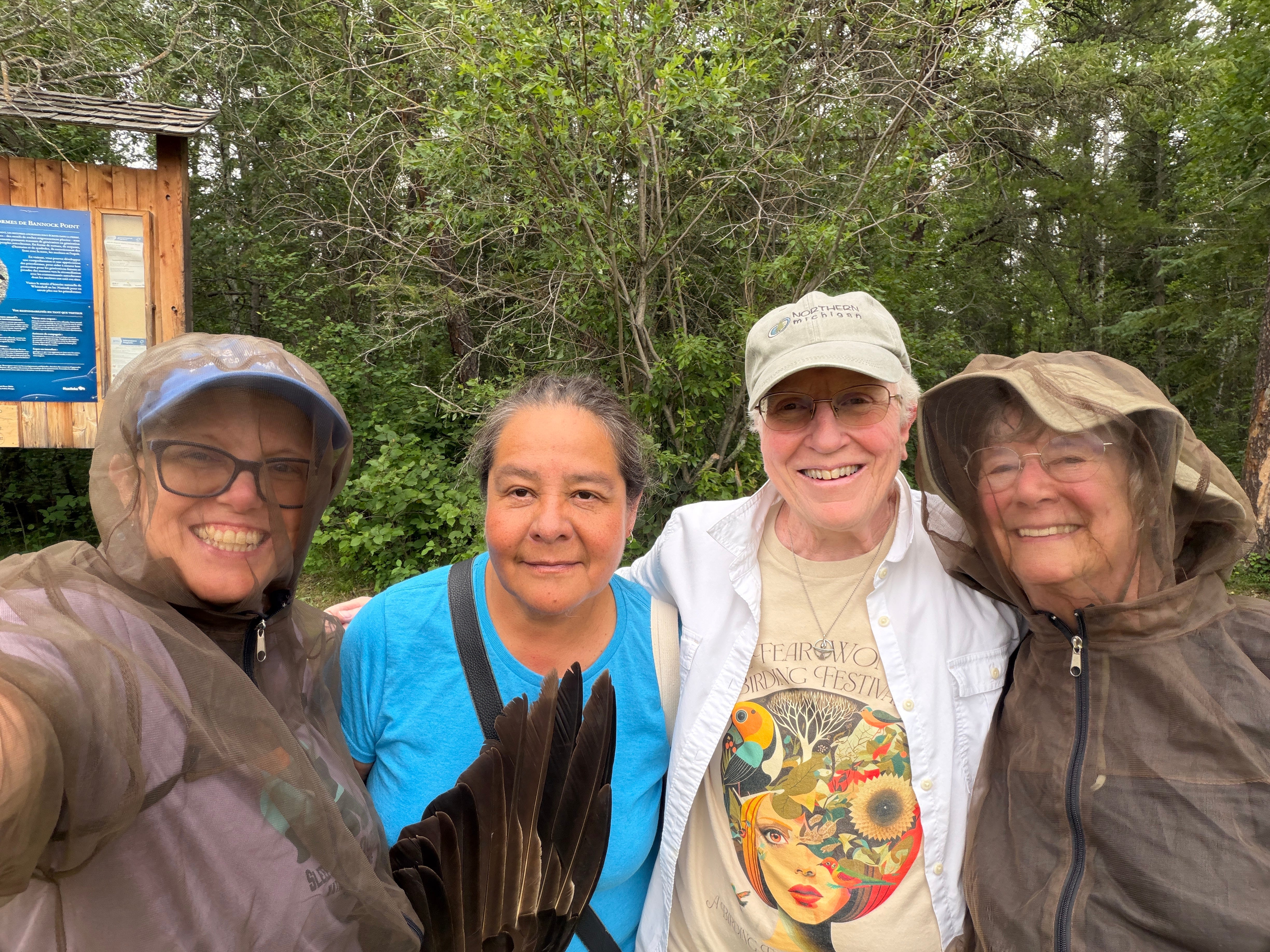
When a car pulls up next to ours, we quickly put on mosquito jackets and head nets and step out of the truck. I’m sure it looks more like we’re planning to enter the Amazon jungle than a roadside park in Manitoba, but we’re determined not to let the dive-bombers of the North distract our focus.
Our guide, who introduces herself as Diane, leads us along the same trail I’d seen the other couple traverse: a boreal forest of jack pine, spruce, fir, aspen, moss, and low-growing shrubs.
After a short walk, we emerge from the forest into an open area—a broad expanse of glacier-smoothed rock. We stop at a large boulder resembling a welcome table in a church. On this boulder, visitors have left small bundles, strips of cloth, and other items.
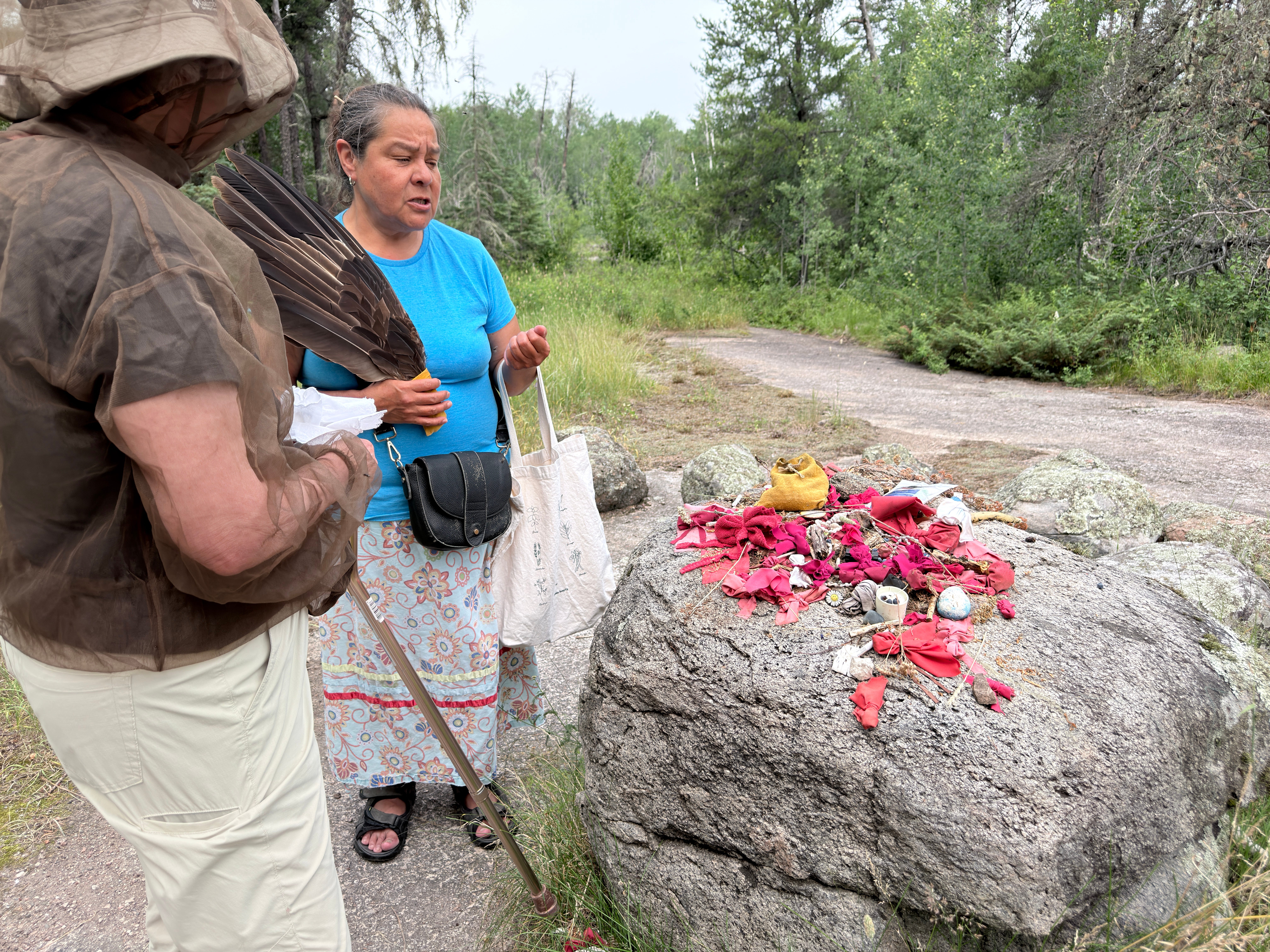
“This is the place to make an offering of tobacco, if you have one,” Diane explains.
We do not, but Charlotte leaves a small gift of sage she had thoughtfully prepared.
Diane tells us that, as we proceed, we can take as many photos on the tour as we like, but no video. “It’s important that people don’t take our teachings and try to share them with others when they don’t know what they mean,” she says.
From there, we cross the weathered granite landscape of the Canadian Shield, the vast region of ancient Precambrian igneous and metamorphic rock surrounding Hudson Bay, to the first petroform. This grouping of rocks covered in moss appears in the shape of a turtle, a creature I’ve long felt a kinship with.
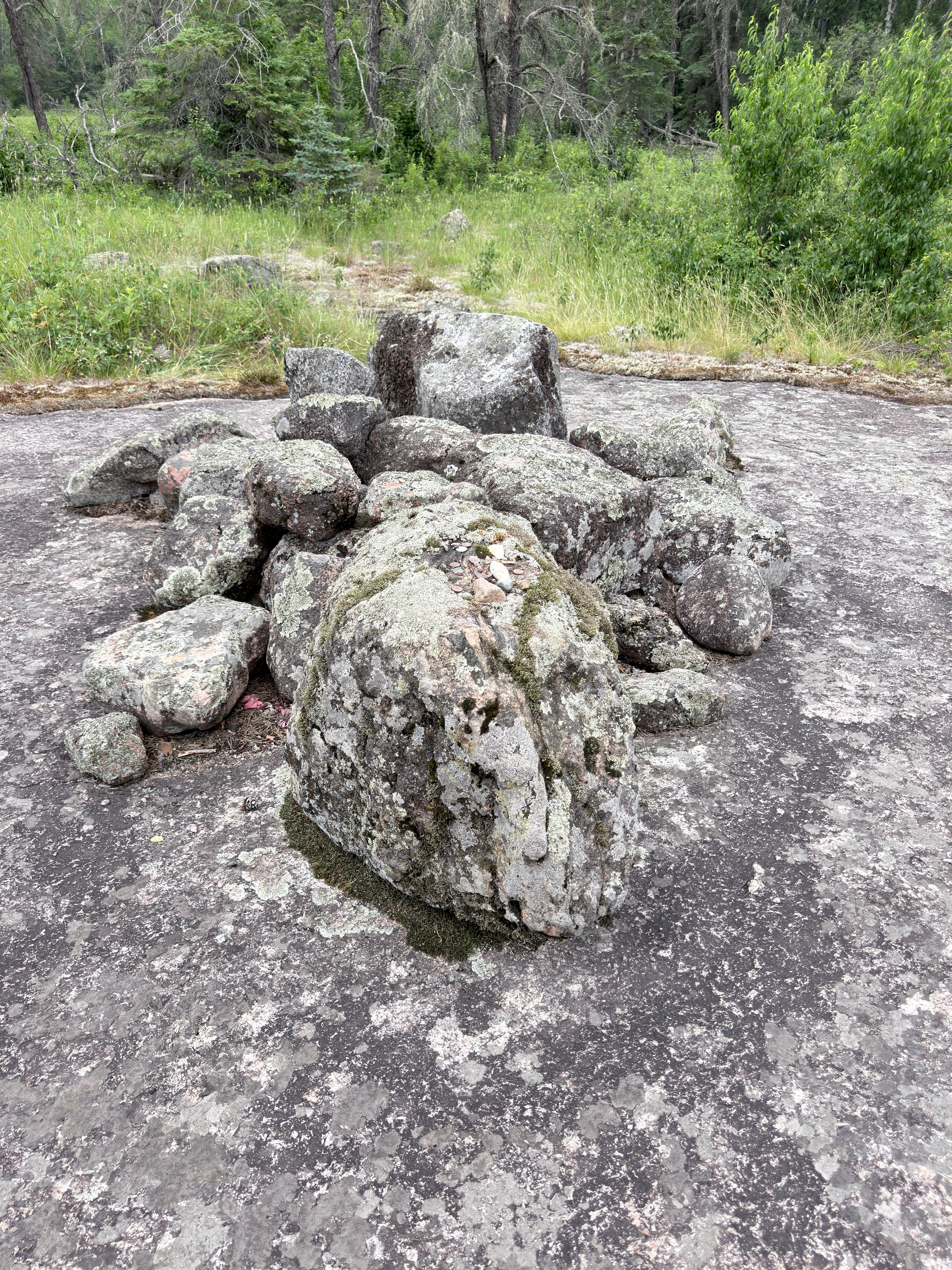
“The Turtle is our living calendar,” Diane says. “The Turtle works with the phases of the moon.”
She goes on to tell the story of how the turtle represents the land masses known today as the Americas and reminds us of our connection to the ancient peoples who traveled before us.
According to Diane, it’s impossible to accurately date the creation of the petroforms. Estimates range widely, from several hundred to several thousand years ago. Some may date to Manitoba’s Woodland period, when pottery became increasingly common and communities continued to travel seasonally along established waterways.
It’s suspected that, because of its proximity to three rivers—the Winnipeg, the Whiteshell, and the Rennie—this site, Manitouabee, which in Anishinaabemowin means “Where The Spirit Sits,” may have been used for ceremonial and spiritual gatherings. These waterways connected Manitouabee with other communities and supported travel and trade throughout the region.
Although archaeological methods cannot identify precisely when the petroforms were created, Ozawa Giizis Ikwe (Yellow Sun Woman), Migizi doodem (Bald Eagle Clan), the woman we know as Diane Maytwayashing, identifies them as the work of her Anishinaabe ancestors and is clear about their purpose.
On her website, she writes:
These stones are set up into various shapes of turtles, water serpents, thunderbird, and sacred women beings – sky woman, spider woman, and a woman giving birth. The Anishinaabe people say that these stone formations align with the star constellations, and for this reason it is the stars that gave the people these instructions of how [we] must live our lives in balance with Mother Earth.
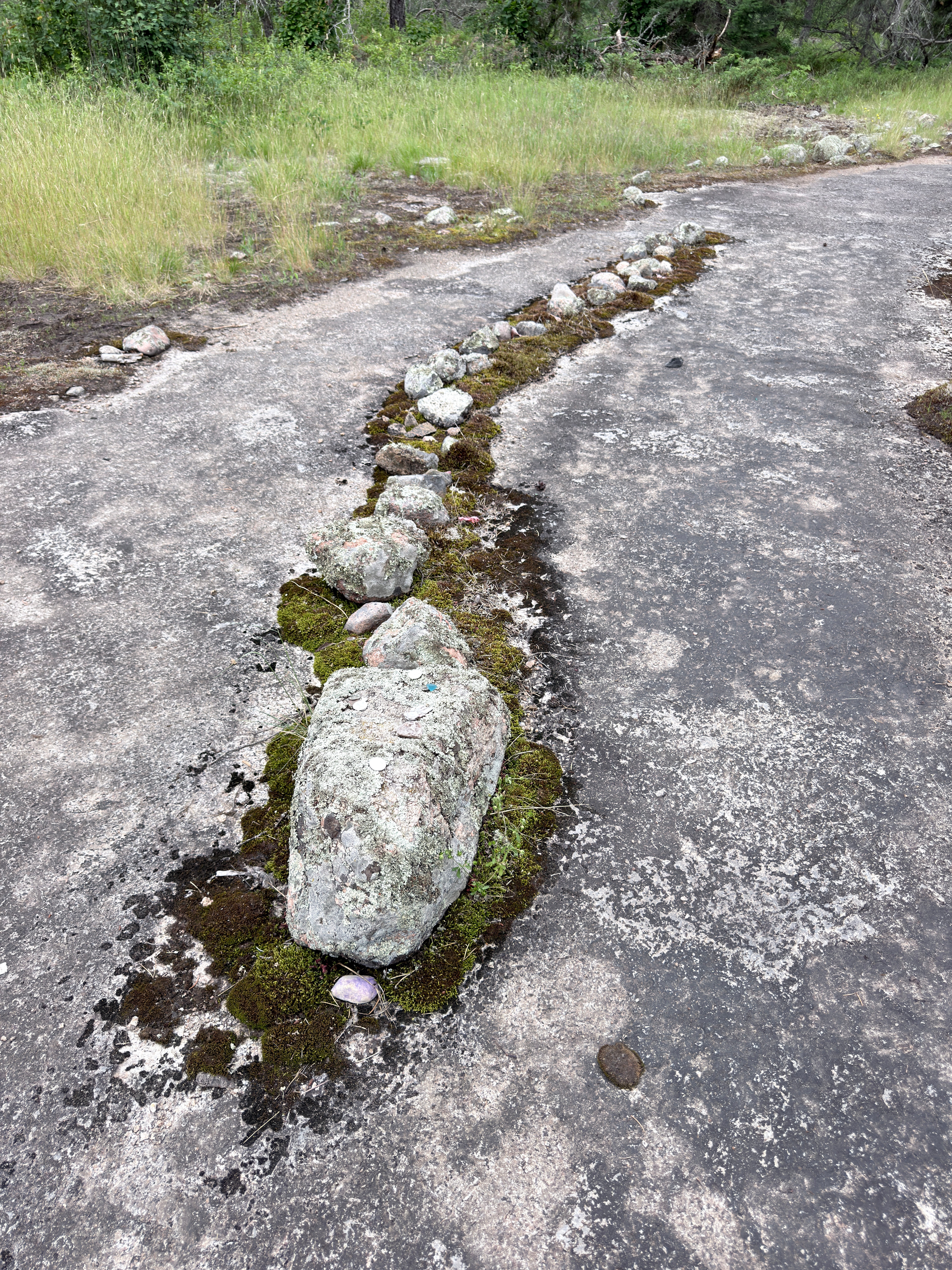
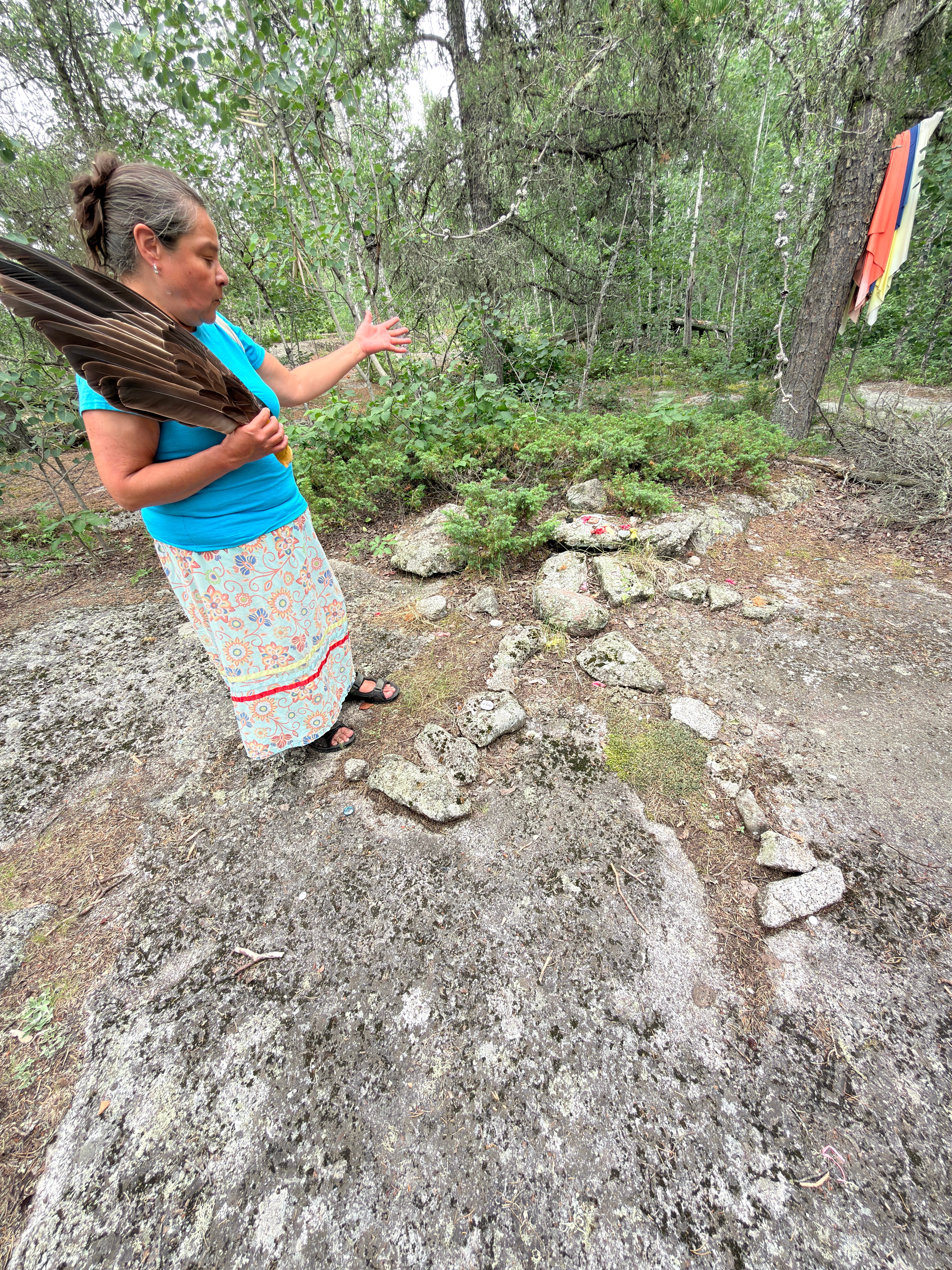
As we pass a ceremonial circle created in more recent times, she describes how Anishinaabe people gather here today to light fires in each of the four directions, drum, dance, share food, and connect with one another and the natural world. Together, they draw on the healing power of a place where their ancestors also gathered for ceremony, community, and spiritual guidance.
Diane tells us that when a spiritual teacher first brought her here nearly thirty years ago, she had no idea that such a powerful place existed. On her website, she writes about this experience:
It was a powerful feeling – as though I were stepping into another dimension. This special place forever changed my life. It felt as though I stood at the gateway to a Great Spiritual Domain, and that is just what happened that day. I stepped into a Spiritual Domain.
What is a sacred place?
The deeper we get into this land, I find myself wondering: What makes a place sacred? Isn’t all land sacred? What makes this place special? Is it really the ancient petroforms, or is it something else, something not defined by the simple arrangements of these rocks? Maybe, in fact, the rocks represent the sacred that is infused in the surrounding landscape.
As Ozawa Giizis Ikwe guides us through the stories and teachings of this place, she makes the presence of earlier generations palpable. Through her words, I begin to sense the sacredness present in the land.
I can feel the energy of generations blowing through the trees and across the granite landscape. Standing there, I try to imagine the people who might once have gathered on this land. The smell of smoke from the ceremonial fires wafts up into the trees. Several decorated clay pots rest beside a cooking fire, one pot holding a mixture of moose, wild rice, broth, and rendered fat, while others boil animal bones to extract their rich grease. Fish from the nearby lakes hang on wooden racks in the smoke to preserve them for later.
In my imagined scene, people move between the fires in soft garments of smoke-tanned hide. Dyed porcupine quills trace bright geometric patterns along their moccasins, leggings, and the edges of dresses; shells, bone pendants, and small pieces of copper sparkle as their wearers turn in the firelight.
This is what is sacred about this land: generations of Anishinaabe people have come here—and continue to come here—to pray and fast, seek spiritual guidance, and pass along their stories and teachings. They remind us that the spirit is infused in all things, and as human beings, we are called to show respect, open ourselves to learning what the land has to teach, and encourage others to do the same.
Earlier this week, I attended a brilliant local production of one of my favorite musicals, the rock opera Jesus Christ Superstar. In the song, “Hosanna,” Jesus responds to the religious leaders who want silence from the crowd with:
If every tongue were stilled
The noise would still continue
The rocks and stones themselves would start to sing!
Lyrics by Tim Rice; music by Andrew Lloyd Webber
When I heard that familiar Biblical reference, I couldn’t help but be transported back to the petroforms. The rocks and stones of the Bannock Point Petroforms, the place “Where the Spirit Sits,” have indeed continued to sing through the centuries and will continue for centuries to come. Whether we hear what they are telling us depends entirely on our willingness to listen.
Yours in peace and beauty,
Annette
If you connect with this post, I’d love to hear from you. Every comment you leave and every time you share a post, you improve the visibility of this post for other Substack readers. So, for both reasons, your comments and shares are especially appreciated.
Annette’s Wanderings is a reader-supported publication. All my posts are free for everyone. But even though I don’t put up paywalls, a paid subscription goes a long way to helping to support my writing. Please consider becoming a monthly or yearly paid subscriber. If you’re one already, you have my undying gratitude! Thank you for all your support!
This was really beautiful, Annette - thank you for sharing your impressions (and photos!) of this sacred place.
It wasn’t until I found “my place” that I ever understood about resonating with physical spaces. I don’t “nest” in that I can’t create a space that nurtures me. I’m not visual in that way. But the moment I stepped into the Bay Area and smelled the eucalyptus and heard the ocean waves and saw the limitless expanse of the ocean and felt the fog on my skin and saw how the rolling hills merged into the sea, I knew I was home. My two years there honed that sense of being home, physically and psychologically. I can still feel it when I cast my self back there. Is it sacred? I don’t know. But it feeds me in ways I didn’t know I was hungry for. That place, and the huge boulders to rest in along the northern Atlantic shore, are where I come alive in new ways.