


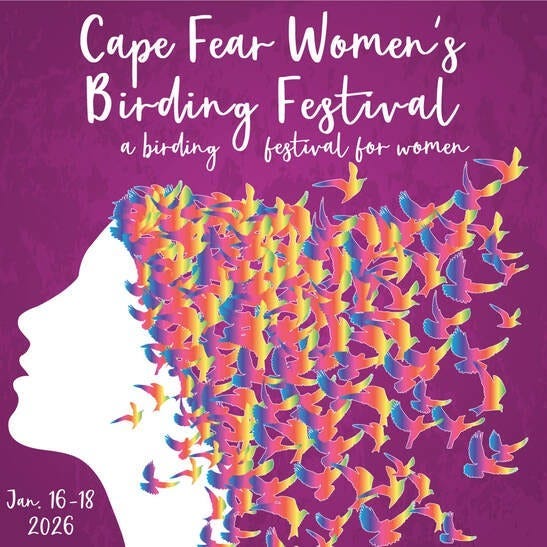
Last year, my wife Wendy and I took a risk. I don’t know how it came to our attention, but somewhere, somehow, we learned about The Cape Fear Women’s Birding Festival, to be held for the first time ever, in Wilmington, NC, in January 2025. Struggling with our grief, disappointment, and anger from the recent presidential election, we had to do something other than mourn and gnash our teeth. This seemed like the perfect antidote. We registered in December 2024, Wendy took an extra day off school, and we headed down to Wilmington (about a four-hour drive from Richmond), for Martin Luther King, Jr. Day weekend.
According to the festival’s website:
The Cape Fear Women’s Birding Festival is designed to bring together women birders in a safe and supportive environment. Our goal is to provide a space for beginning birders to develop field identification and bird photography skills, and to allow women birders of all skill levels to meet each other, share information, discuss equipment and trips, and explore the diverse and majestic avian ecology of the lower Cape Fear region.
To be honest, we didn’t know what to expect. We had our pre-conceived notions, of course. The attendees would be retired, sporting gray hair and khaki pants, wearing wide-brimmed sun hats with hair pulled back in a ponytail or braid, a pair of binoculars glued to their eyes, and a well-worn field guide bulging from a jacket pocket. They would be able to identify the most obscure bird by its call a hundred yards away and have no time or patience for amateurs.
Of course, except for having my hair pulled back (it’s too short for that) and being able to identify bird calls at any distance, that description would fit me on a lot of days. Oh, and replace the binoculars with a camera and a long lens. Then it’s me.
But were we ever wrong!
This festival drew women from various age groups, professions, and interests. Some were beginners like us and others were champion birders. Several professional photographers joined other hobbyists like me to discuss ideas for capturing the perfect bird photograph.
Even though we knew our bird identification skills would never rise to the level of some of these women, we loved their passion. And the best part? Despite the constant rain, drizzle, and otherwise unpleasant weather, no one complained. People just donned their raincoats, covered up their cameras, and went out in search of birds.
We had such a good time on this mid-winter escape that when the opportunity came up to go again, we jumped on it. Unfortunately, when we registered last summer, we didn’t think about the fact that it would be inauguration weekend for Virginia’s first female governor, Abigail Spanberger. We regretted missing that, but with a promise of better weather than last year, we looked forward to the weekend.
And it did not disappoint. We gathered at a seaside resort on Wrightsville Beach for the opening session. One hundred and fifty women birders all in one place! The birds didn’t have a chance. We later learned that only twenty-five had returned from last year, so this was a relatively new crop of birders, mostly hailing from the Carolinas and Virginia, but some from farther away. And they were ready!
On Friday evening, two presenters regaled us with tales of hummingbirds and coastal birds. Did you know that people actually band those little hummingbirds so other people who study them can identify a previously banded bird and learn something about their travels? They’ve even starting to outfit them with tiny radio transmitters so scientists can track their migrations and habits. Mind-blowing!
The most useful and surprising thing I learned is that the birds I would have previously grouped together as shorebirds or water birds fall into several broad categories, referred to, in scientific terminology, as the Order—large groupings based on evolutional relationships (the birds listed here frequent the Atlantic Coast. Depending on where you live, you might have different examples):
Shorebirds (Waders), such as Sanderling, Ruddy Turnstone, Black-bellied and Semipalmated Plover and American Oystercatcher. They’re the ones you see running along beaches and probing mudflats.
Seabirds, such as Laughing Gull, Herring Gull, Great Black-backed Gull, Ring-billed Gull, Common Tern, Brown Pelican, and Black Skimmer. Seabirds (notice I never said, “seagull,” that’s the surest sign of an amateur! No bird is a seagull. Sorry, Jonathan!). Seabirds feed mostly offshore but gather near beaches, piers, and inlets.
Wading Birds. These are the Herons (Great Blue, Tri-colored, Green, and Little Blue), Egrets (Great and Snowy), Ibises (Glossy and White), and Spoonbills. (Roseate). These are the strikingly tall birds you see stalking fish and crabs in shallow water, especially salt marsh creeks, lagoons, and tidal pools.
Waterfowl, such as American Black Duck, Red-breasted Merganser, and Black Scooter. You usually see waterfowl in bays, sounds, inlets, nearshore water diving for their food.
Marsh Birds, such as Clapper, King, and Virginia Rail, Common Gallinule, Seaside and Nelson’s Sparrow, and Marsh Wren. These are secretive birds (and so are prime targets for birders to add to their life lists), who live deep in salt-marsh grasses.
Coastal Raptors, such as Osprey, Bald Eagle, Peregrine Falcon, Northern Harrier, and Red-tailed Hawk. You’ll find them soaring in the sky or hanging out in dunes, coastal forests, marsh edges, and on bridges and powerlines.
I doubt I’ll ever learn to reliably distinguish a Laughing Gull from a Herring Gull or a Snowy Egret from a White Ibis without the aid of Merlin Bird ID, but knowing the category (Order) they fall into helps me to feel a little less ignorant when I have them sighted through my camera lens.
Enjoy these photos from the weekend.
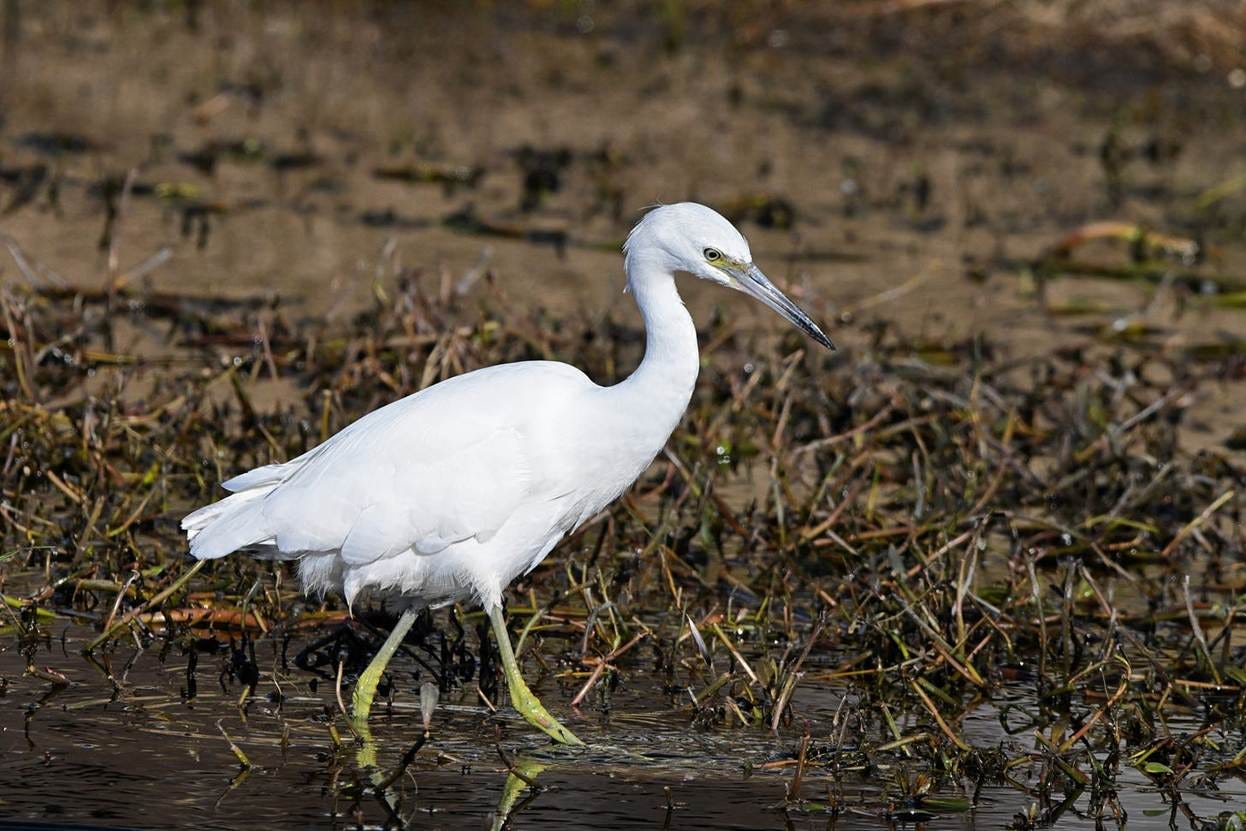
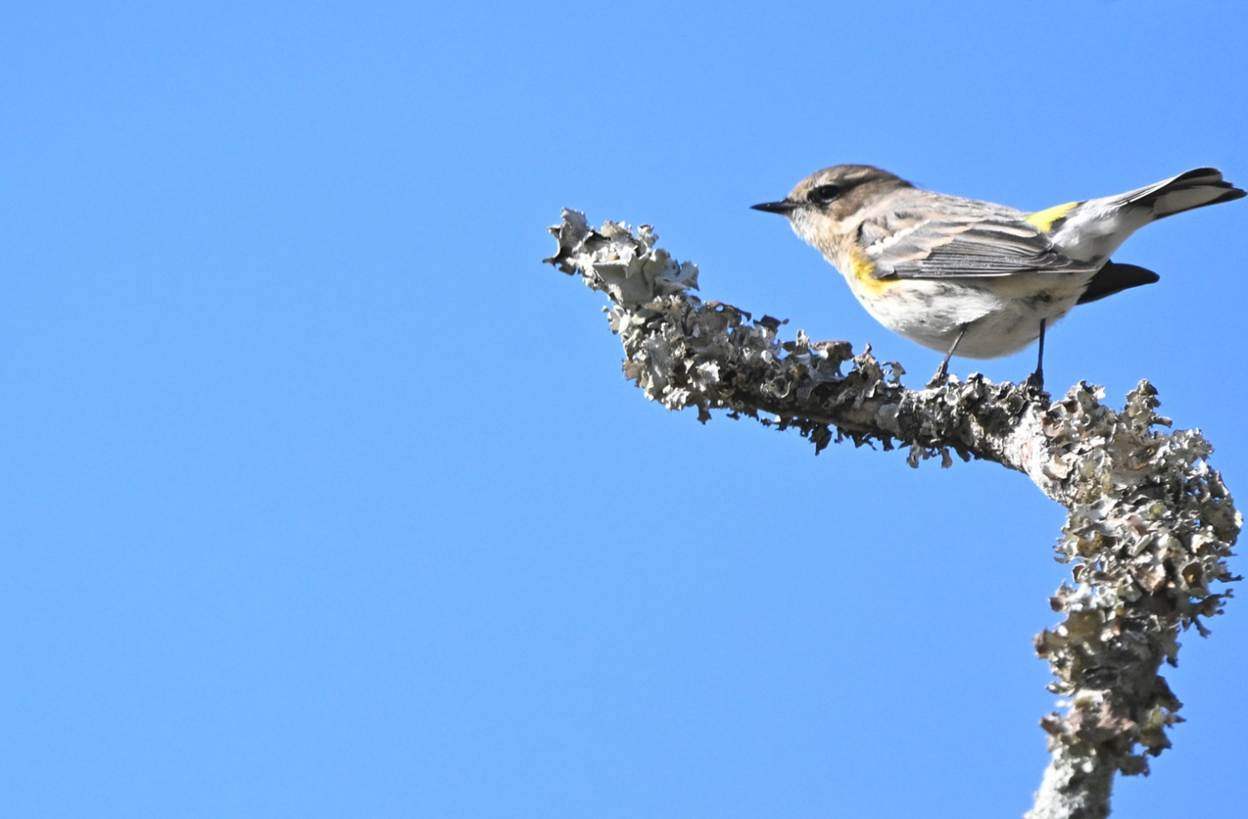
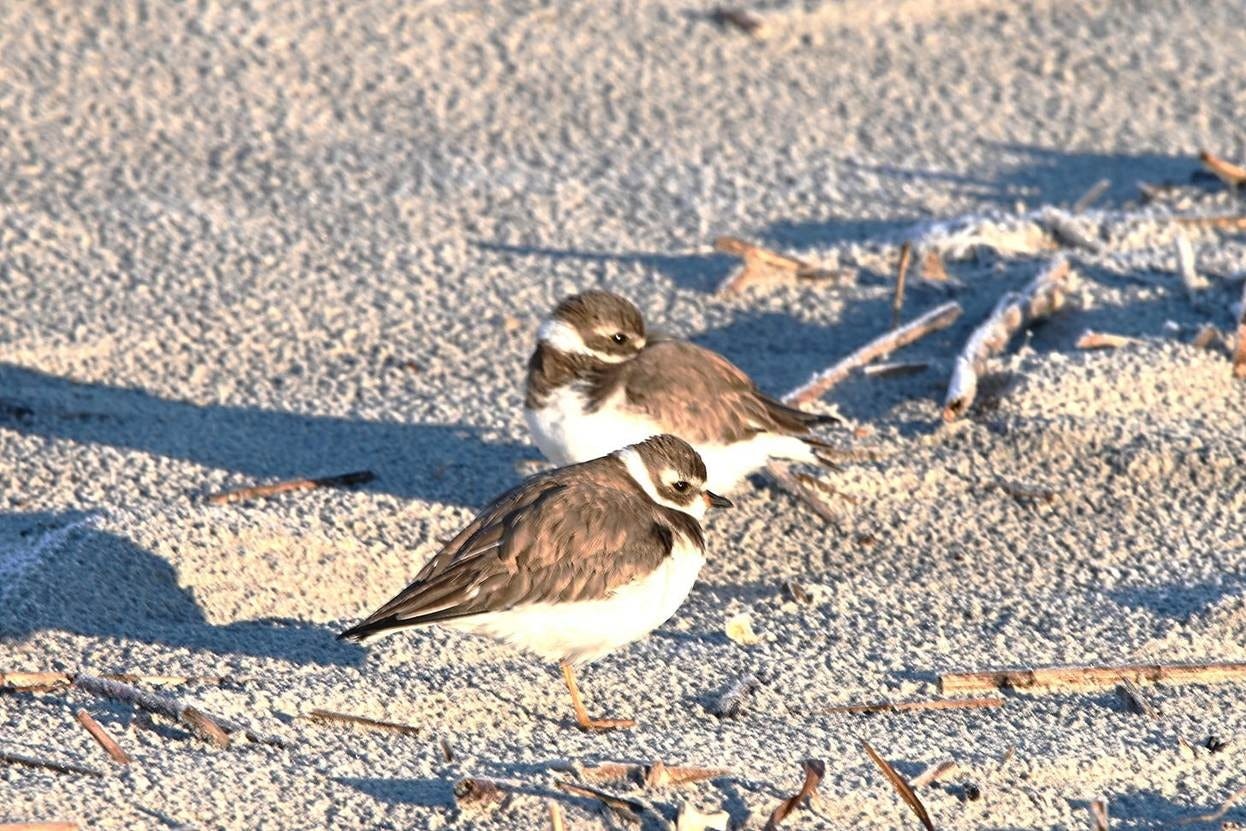
Many of the women at the Birding Festival can hear a sound and instantly tell you what it is—not just the Order, but all the way down through the Family and Genus, to the specific Species. They will call it out as if they just won at Bingo. “Bingo! That’s a Yellow-rumped Warbler!” Bingo! That’s a Black-crowned Night Heron! “Bingo! That’s a Sharp-shinned Hawk!”
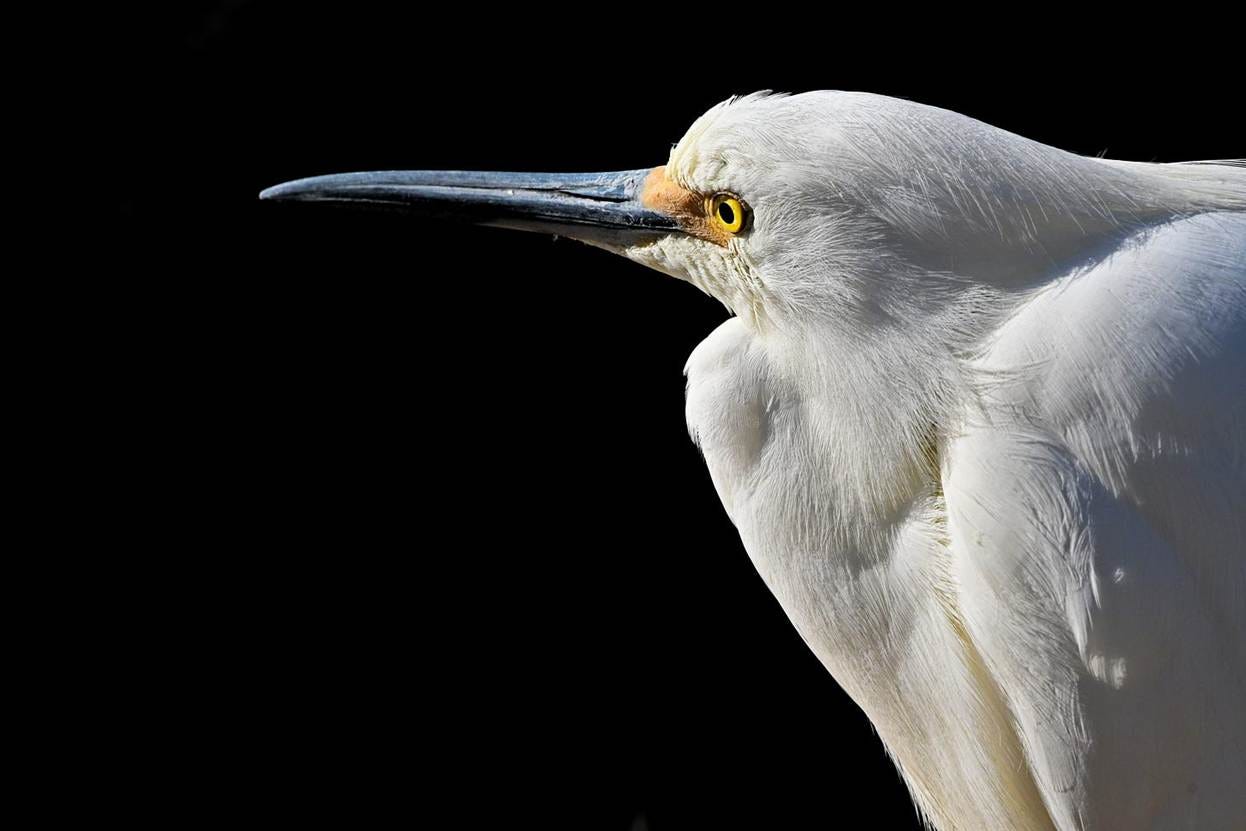
The best I could do was look where they pointed and try to distinguish the bird from the foliage or other birds that surrounded it. This is one that stood out.
The Power and Peril of How We Sort
This trip got me thinking about the usefulness of categories—about how humans gravitate toward categorizing things. Humans categorize because it’s how the brain manages complexity. Categorization not only reduces complexity, it supports our learning, and helps us make decisions efficiently.
In the case of birds, it helps us learn about a particular species and how it differs from another species. Through categorization, we can recognize patterns and even predict behavior and characteristics. Once you recognize something as a “bird,” you already know it likely flies, has feathers, and lays eggs. Knowing what species of bird it is, tells you even more about its nesting habits, food preferences, and how they rear their young.
Categorization also helps us distinguish predator from prey and know if we’re in a safe or unsafe environment. A male Northern Cardinal, with its bright red plumage, is easily identified by a Red-tailed Hawk, and therefore knows to hide when a hawk is heard or seen nearby. Categories turn a messy world into patterns that can be understood, shared, and acted upon.
What happens, though, when we apply categories to humans? It doesn’t matter if you’re from Somalia, Mexico, the Philippines, or Canada, if you prefer hamburgers or dal, if you wear flannel shirts or kimono, if your skin is midnight dark or porcelain white, or if you speak Russian, Swahili, or K’iche’, humans around the globe are all one species: Homo sapiens. Chimpanzees (Pan troglodytes) and bonobos (Pan paniscus) come close, sharing 98-99% of our DNA, but they are not Homo sapiens.
I’ve discovered that I have more Neanderthal DNA than 94% of 23andMe genetic testing customers, but that’s still less than 2%. Homo neanderthalensis lived in Europe and western Asia until about 40,000 years ago and interbred with early modern humans, but they were not Homo sapiens.
Throughout the course of human history—about 192,000 years—117 billion Homo sapiens have been born and 109 billon have died. That leaves 8.3 billion (8,300,000,000) of us who are still alive at this moment. And, unlike birds, WE ARE ALL ONE SPECIES. Despite this, we often treat others who are different from us, who are outside our experience, as another species that we have to protect ourselves from. We categorize the unfamiliar as dangerous and build stories about why.
Challenging a Myopic World View
As I learned more about birds, I began to ponder what birds had to teach us humans about categories and differences. This led me to wonder what the most common bird species in the world today is. Surely, it’s the House Sparrow or European Starling, I mused. They’re all over my yard, attacking my favorite Eastern Bluebirds, scarfing up seeds like there’s a BOGO sale at Wild Birds Unlimited, and bullying every other bird species they encounter.
What I discovered, however, is that I had once again fallen victim to a myopic world view. These are the birds I know, the ones I see every day—so of course I assumed they must rule the skies around the world.
Because one of my personal commitments to anti-racism/anti-oppression work is to challenge my limited perspective, what I learned after researching the question didn’t exactly shock me, but it did delight me. Are you ready? The most common wild bird species in the world (excluding the domestic chicken) is one I’d never even heard of—and I’m guessing you haven’t either: the Red-billed Quelea.
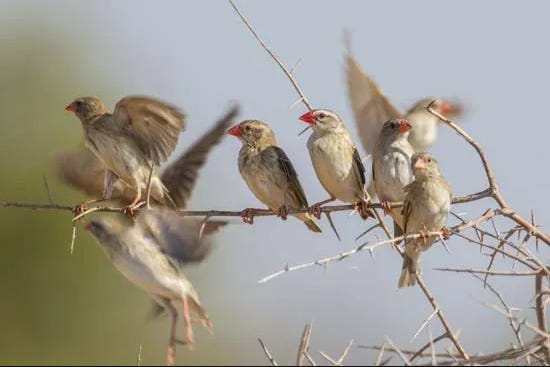
A member of the weaver family (Ploceidae) found in sub-Saharan Africa, the Quelea form enormous flocks that feed mainly on grass seeds, sometimes devastating crops like millet. I’ve never seen a Quelea. They don’t frequent my neighborhood. And yet they exist in the billions. Audubon estimates that about 1.5 billion Quelea are alive today—roughly one Quelea for every 5.5 Homo sapiens on the planet.
Because I had never heard of the Quelea, I felt confident the birds in my backyard must dominate the planet. How often do I do the same with people—assuming the small patch of world I inhabit is the whole map?
As I watched YouTube videos of millions of Quelea descending on a field or outsmarting a predator, I caught myself thinking about how easily we humans decide what we think we know about people we’ve never met.
I see this instinct everywhere—in how we talk about immigrants and refugees, in the shorthand we use for people who vote differently than we do, worship differently than we do, or come from places we’ve never visited. It’s tempting to let a headline, a preconception, or a stereotype stand in for millions of complex lives. I do it too, catching myself forming opinions long before I’ve done the slower work of listening and learning about people’s experiences, motivations, and cultural expressions.
What might change if we approached unfamiliar people the way birders approach an unfamiliar species—not with fear, but with curiosity and patience?
What if, instead of shouting Bingo, we paused long enough to admit we don’t yet know what we’re looking at, but commit ourselves to finding out?
Maybe my real work is remembering how often I’ve been wrong before—and letting that humility open the door to seeing birds and humans more clearly next time. Will you join me?
Yours in hope,
Annette

Annette, there is so much of value packed into this one post! First off, I’m a bird lover but no expert, and I love watching birds and using the Merlin app to identify them by their calls. I enjoyed your description of the two festivals you and your wife attended. Secondly, the reminded that all humans are of one species is a powerful one. Yes, we must look more closely at our biases and forestall those knee-jerk judgements about the “stranger.” We are all one, and we are all “other.” Or fears so often dictate how we choose to act toward those we haven’t met. Thanks for a powerful essay!
My fantasy is to learn to look at the world as you do and extract powerful messages that help me understand the world around me. Thanks for this wonderful post.