


The sun had begun its descent, but the temperature still hovered around 88 degrees. If it had reached the previous day’s ghastly 98 degrees, the Richmond Symphony would have been contractually prohibited from performing on the makeshift stage beside the Richmond docks. As it was, their concert celebrating Richmond SailFest and the 250th anniversary of the United States of America faced a delay because the sun shone directly on the violins and violinists—another contract violation.
As the crowd waited for the sun to drop lower in the sky, children played on the lawn and adults chatted with each other or sat quietly taking in the scene. By the time the guest conductor finally appeared on the stage, the crowd was ready.
Directly across the James River within view of this new waterfront park sits another dock: Ancarrow’s Landing. In the decades before the Civil War, that dock served as part of the massive slave trade that made Richmond one of the largest sources of enslaved Africans on the east coast of America.
In deference to that history, the symphony didn’t begin with “The Star-Spangled Banner.” Instead, it opened with a solemn version of “Lift Ev’ry Voice and Sing,” a hymn of faith, endurance, and liberation, often called the Black national anthem. Written as a poem by James Weldon Johnson in 1900 and later set to music by his brother J. Rosamond Johnson, this hymn became, and still serves today, as a powerful song of hope and collective memory for African Americans.
The juxtaposition of the setting along with the symphony’s musical selections, which also included “The Star-Spangled Banner,” a tribute to the Tuskegee Airmen, “America the Beautiful” (written, by the way, by a lesbian English professor, Katharine Lee Bates), and the requisite John Phillip Sousa, showed so much about the complex history of this country we call the United States of America.
Here’s a quick look at the fireworks over the James River later that evening with “Lift Ev’ry Voice and Sing” once again serving as the accompainment.
As we mark the 250th anniversary of the founding of this country, I’ve felt the tension, as I’m sure many of you have, between pride, prejudice, and patriotism. Should we celebrate this anniversary.? Should we ignore that it’s happening? Or should we use it as an opportunity to call on America to fulfill its promise?
Learning to be an American
Every day in my Catholic elementary school in Arkansas, we pledged our allegiance to the USA. As a child, I took pride in our country. I learned that it was a democratic nation formed on the premise that all men [sic] are created equal. I learned that it was the greatest country on Earth, and I believed it.
As the nuns introduced me to US and Arkansas history, I discovered that I loved the stories of the American Revolution, the pioneers, and the conquering of the West. When I was five and six, my family lived in Colorado and spent our summers exploring the western states. As a result, by the time I could read about history in school, I’d already encountered American Indians, attended pow-wows, and visited the cliff dwellings at Mesa Verde. I knew that immigrants, mostly from Europe, had decimated the Indian populations, but I didn’t know enough to understand the immorality of their actions. Instead, I relished learning about the history of this great nation.
As I grew a little older, I came to understand that the history of the United States is much more complicated than it appears on the surface. This understanding grew when I learned that Black people couldn’t stay overnight in my town without risking being attacked because of the color of their skin. I then learned that we didn’t have to deal with school desegregation like other communities near us because there were no local Black schools. People in my town were grateful for that. I became curious about Mexican migrant workers who worked in nearby chicken plants and why none moved to the sundown town (a term I learned much later) in which I lived, but, again, all I heard about it was how lucky we were.
I was also intrigued by poor White people. The woman who cleaned our house twice a month lived in a sharecropper’s cabin outside of town. My family marveled at the fact that she had no electricity or running water and had to get a ride with the property owner into town because she had no means of transportation.
I knew White kids in my junior high school who lived in broken-down shacks at the edge of the town dump. Scavengers, my friends and I called them. We fantasized about what treasures they might find among the town’s discards, especially when we threw something away we thought they might like.
But even with all these inequalities around and within me, I was taught that if you worked hard enough, pulled yourself up by your bootstraps, you could make it in America. Anyone who didn’t was lazy, unlucky, or ill.
As an adult, I learned how very wrong this conviction was. In order to pull oneself up by your bootstraps, you first have to have boots. Inequality of opportunity is not a personal choice. It’s a societal condition that requires societal solutions.
The promise has never aligned and yet, we keep trying
Despite what some might have us believe, America’s moral compass has always been skewed. We enslaved millions of people stolen from their home countries in Africa. We annihilated Indigenous tribes to claim land that was not ours. We relegated African Americans and other people of color to second-class, or more likely, third-class citizenship. We excluded Chinese people, imprisoned Japanese Americans, attacked Muslims, and once again, have declared a war on decent, hard-working immigrants.
A few years ago, I produced and narrated a video for an anti-racism workshop series I was a part of leading. The video focuses on America’s history of racism, especially on Black Americans. In it, I stressed how with every attempt to systemize discrimination against people of color in this country, there has been and continues to be strong multiracial resistance movements to counter those attempts. Americans do not sit idly by when rights are being denied. That’s the America I love—one willing to fight for the rights of all people, to ensure that the American dream is available to all.
If you’re interested in watching this (38 minute) video, I’ve posted it here.
Unfortunately, racism didn’t end in 2021 after I published the video. So much more has happened since then and continues to happen every day that’s not documented in this film. However, it may be cliché, but I still believe that, in the oft-quoted words of Theodore Parker, a 19th-century Unitarian minister and abolitionist, “The arc of the moral universe is long, but it bends toward justice.”
What if?
The United States is different from many other countries in one fundamental way. This country is based on a civic national identity rather than inherited ancestry. It defines belonging through citizenship, law, and shared public ideals. According to Yoni Appelbaum in his article, “How America Gave Up on Its Own History,” published in The Atlantic earlier this month, “America defined itself as a democratic government ‘of the people, for the people, by the people.’ As a nation, we espouse ‘commitment to a common creed—of equality, rights, and opportunity.’”
Despite what the neo-Nazis chanted at the 2017 Unite the Right Rally in Charlottesville, we are not a nation built on “blood and soil.” Applebaum goes on:
Americans defined their nation in this way, by their commitment to a common creed—of equality, rights, and opportunity—and to a corresponding set of democratic ideals that they were modeling for the world. In practice, they generally fell short of those principles, sometimes seeming to pursue their abnegation more than their fulfillment. But the white men who built their fledgling republic around an idea, instead of around a common ancestry, opened the possibility that any who subscribed to its creed could become a citizen. Over time, other Americans demanded that the nation live up to its ideals and recognize their equality. For more than two centuries, our creedal nationalism has been a source of strength, binding together Americans of diverse faiths and backgrounds.
What would it mean to change the narrative so that we lived up to our ideals, to our common creed? What if our priorities shifted from attacking immigrants to ending food and housing insecurity and addressing the growing climate crisis? What if we made it possible, and, in fact, even encouraged people to come to and stay in this country as long as you worked or studied hard and contributed to the collective good? What if we built and supported immigrant-rich communities where everyone, including American citizens, had what they needed to not only survive but thrive.
I’m confident that if we did this, we would flourish as a country, and, because America would be making moral choices, the world would thrive too. It’s what I believe is meant by “in order to form a more perfect union” stated in the Preamble of the US Constitution. We can’t stop working on it. We can’t let those who are determined to change the very essence of this country win.
Pride in our principles
I believe that America still has the potential of being/becoming a model for the world. Our religious pluralism, racial diversity, ethnic heritage, interests, and politics is our strength. It’s the ideal on which our country was built even as we failed and continue to fail time and time again to live up to that ideal.
I believe that progress never happens in a straight line. Instead, although it’s a mostly horizontal line, it contains loops, breaks, knots, repairs, and upward bends, stitched together in places where the nation has to mend itself.
For many of us, this feels like a hopeless time. Those of us who’ve spent a lifetime fighting for racial equality, civil and human rights, women’s rights, LGBTQ rights, disability rights, and immigrant rights, have watched much of this work evaporate in the last eighteen months. However, I refuse to believe that we should give up. We must have faith that this country has a strong enough foundation to withstand even these overwhelming assaults on it. We have come a long way, and although we still have an even longer way to go, I believe that we will mend ourselves and move forward again, no matter how long it takes.
Creating the nation we want America to be requires us to lift up and celebrate the good things, the moral things, that give up hope in future possibilities.
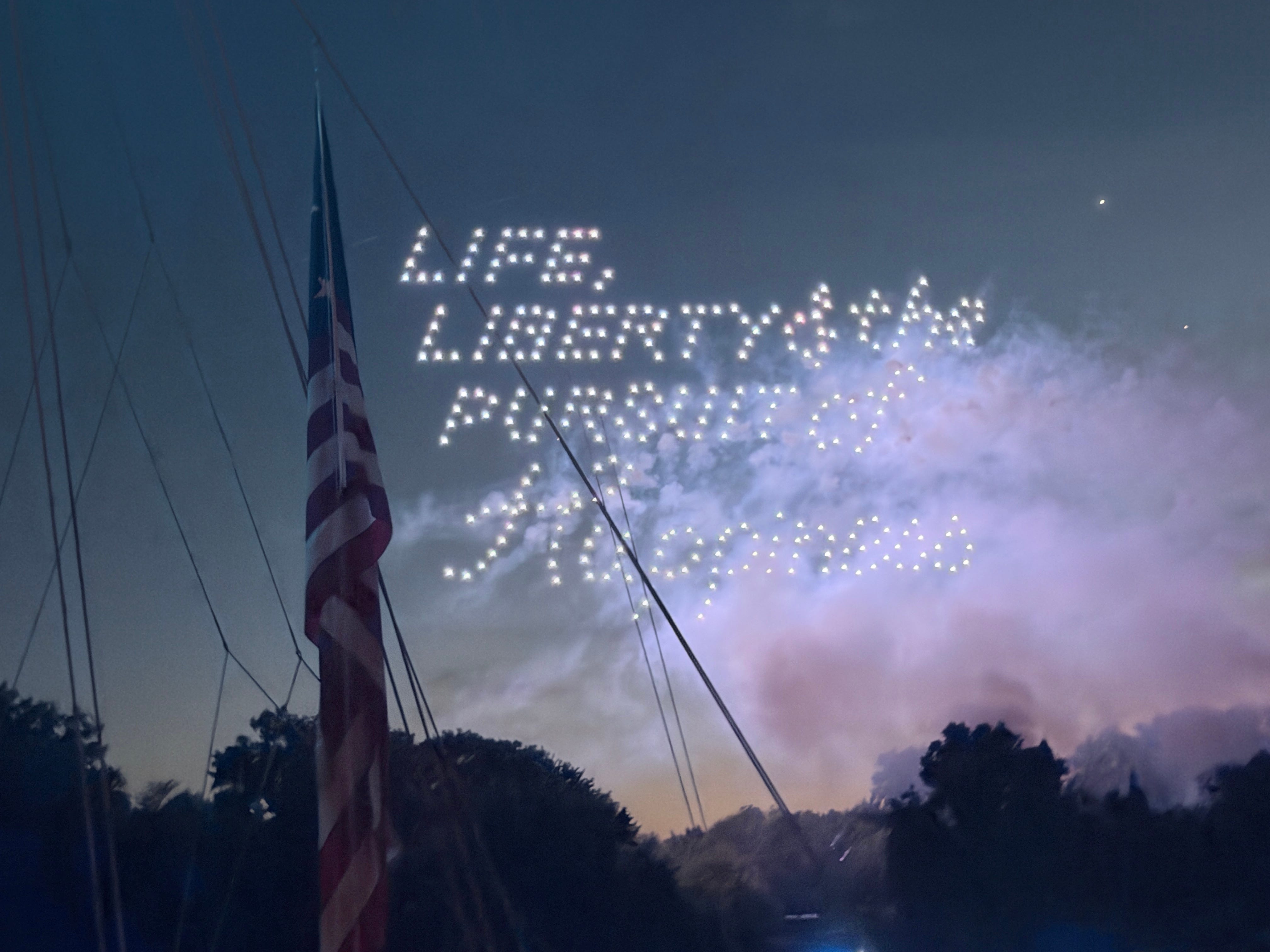
As we approach July 4th 2026, I encourage you to think about what parts of this country’s history you are able to celebrate. Maybe it’s the freedom fighters of the American Civil Rights Movement. Maybe it’s the 19th century abolitionists. Maybe it’s the climate activists who are risking everything to stop global climate change. Maybe it’s the suffragists who chained themselves to the White House gate to secure women’s right to vote. Maybe it’s the American inventors and innovators who designed everything from the electric light bulb to the internet.
Maybe it’s Black Lives Matter activists, members of the American Indian Movement, and immigrant rights activists. Maybe it’s lesbian, gay, bisexual, transgender, and queer people who have tried to teach us all that “love is love” and we all have a right to express who we are without constraint. Maybe it’s disability activists who make it possible for more people to participate in everyday activities. Maybe it’s the people who had the foresight to create our national, state, and local parks and preserve the wonder of American geography.
I love all these things and the people behind these movements, actions, and events. These are the things that make me proud to be an American. What resonates for you?
After you’ve reflected on the things that make America special to you, I encourage you to find something to do that honors the good in our country. Here are a few suggestions:
Attend one of your community’s 250th events, enjoy the parades and fireworks, go to a farmers’ market, or spend time at your local history museum. As you do, look for the goodness in the people you see rather than focusing on the attributes that separate us.
Invite your neighbors, regardless of their political affiliation, to a backyard barbeque to celebrate what it means to be good neighbors.
Visit a national park or other places with complicated histories such as monuments, battlefields, cemeteries, schools, courthouses, former plantations, labor sites, immigration sites, protest sites, LGBTQ+ landmarks, tribal lands, or local civil rights sites and be a witness to the acts of courage that took place there.
Invite your friends, family, or faith community to watch Refuge, a documentary that “unmasks hate in America — and makes room for understanding” by chronicling “an unlikely friendship between a Muslim and a white supremacist” and in doing so, “reveals deep wisdom about humanity.”
Honor an ancestor, elder, or predecessor who endured. Choose one person—family member, activist, teacher, neighbor, writer, immigrant, queer elder, enslaved person, Indigenous leader, labor organizer—someone whose life says, I was here too. Learn, write, or tell their story as part of the anniversary.
Celebrate the promise of America without pretending the promise has been fulfilled. Whatever you do, celebrate it in a way that’s true to you. That is the best definition of what America is to me and the most American kind of observance there is. In the comments, please share what you decide to do and what it will or did mean to you.
Happy 250th anniversary! May the next 250 years be filled with resilience, promise, opportunity, and hope for a better future for all Americans.
Yours in peace and promise,
Annette

One of your best, Annette.
So full, complete, complex.
We're here...we cannot give up trying to make life better for everyone. Each of us can do something...and, do it over and over again.
Folks might enjoy Ross Gay's work on joy & gratitude.
Thank you,
Susan Odgers
Thank you, Annette...even in the darkest moments, I'm always looking for ways to be hopeful about the future. That hope keeps me going and fuels my efforts to continue organizing against the regime as well as elect candidates who will work to return our country to sanity. Your writing is a true inspiration.