


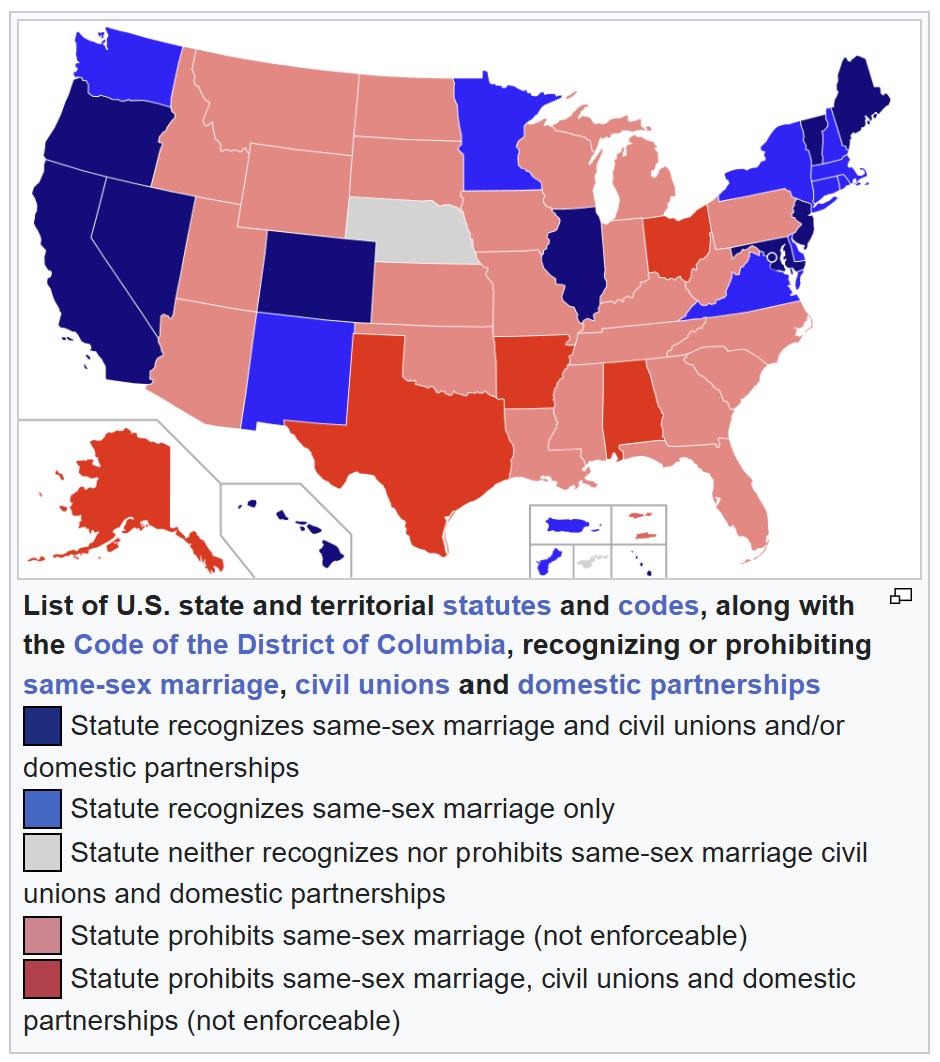
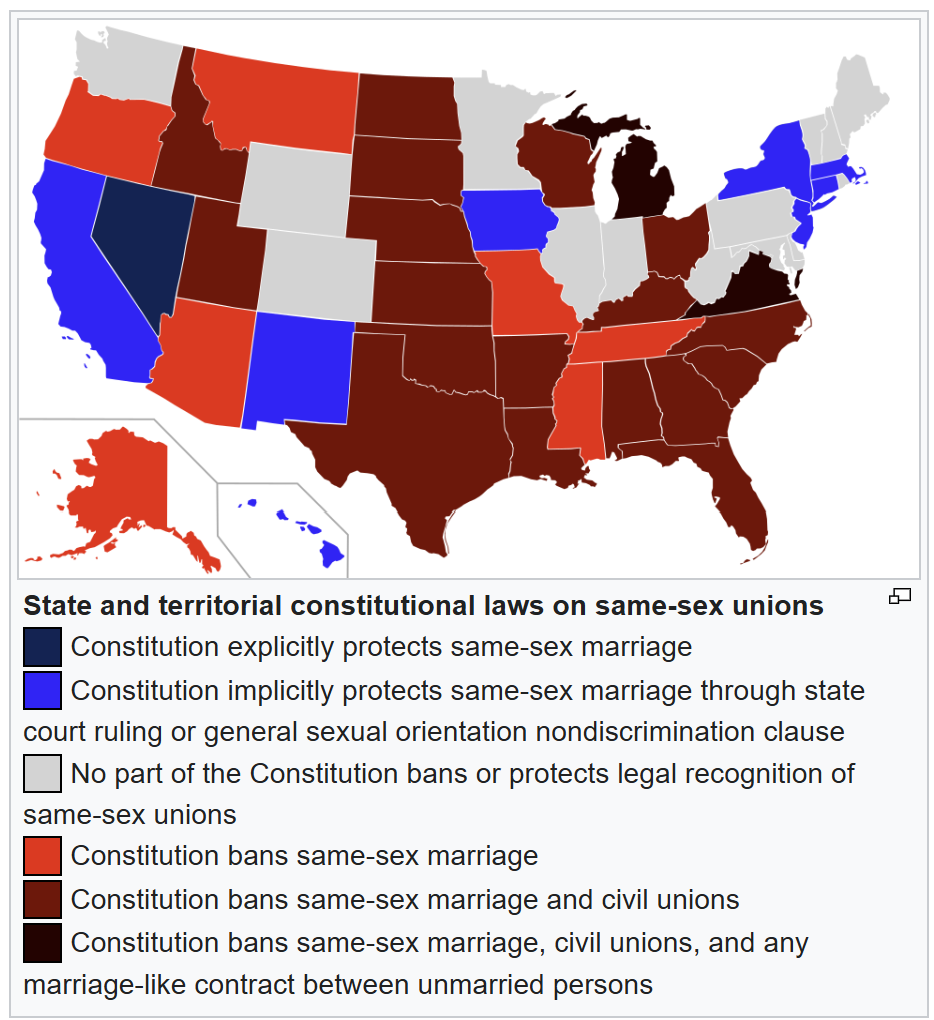
Marriage equality is on the ballot in Virginia this November. Yes, marriage equality. I thought the U.S. Supreme Court resolved that back in 2015, you say. And you’d be right. However, even though they’re no longer enforceable, many states still have statutes prohibiting same-sex marriage and “one man one woman” bans on same-sex marriage in their constitutions.
That means that if the U.S. Supreme Court were ever to overturn Obergefell v. Hodges, the 2015 decision that legalized same‑sex marriage nationwide, states could impose their own bans. Oh, that could never happen, you say. That’s what we said about Roe V. Wade, but, as you know, this decision, which stood for forty-nine years, was overturned in 2022, and abortion bans are rampant around the country. Never say never.
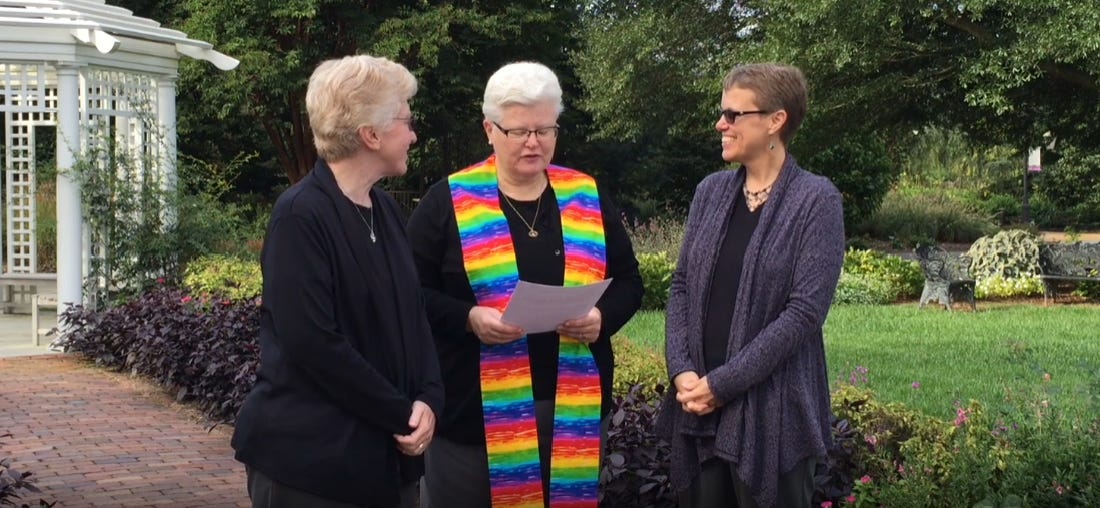
Same-sex marriage has been legal in Virginia since October 6, 2014, following the decision of the U.S. Supreme Court not to hear an appeal of the Fourth Circuit Court of Appeals’ ruling in Bostic v. Schaefer. As a result, my wife and I got legally married on October 7, 2014, twelve years ago today, and almost nine months before the U.S. Supreme Court made it legal nationwide.
As a result of the Fourth Circuit’s ruling, the Virginia General Assembly repealed the statutory ban on same-sex marriage in 2020, but it still exists in far too many states.
Even though the statutory ban has been lifted, the Virginia Constitution - Article I. Bill of Rights - Section 15-A. Marriage, still defines marriage as “only a union between one man and one woman.”
Well, that’s an easy fix, you say. Clearly, the will of the people is behind repealing the bans. I’m not so sure. According to a May 2026 Gallop Poll, “in 2021 and 2022, 55% of Republicans said they favored legal same-sex marriage, but today, the figure is 37%.” The Gallup Poll also found:
Between 1996 and 2022, the percentage of U.S. adults in favor of legalizing same-sex marriage increased by 44 points, from 27% to 71%. In 2024, the figure dipped to 69%, and it has shown a marginal decline each year since.
We’re clearly heading in the wrong direction. In the past couple of years, backlash against LGBTQ people has grown more intense and more acceptable. The only way to turn this around is to return to what worked so well in years gone past—to remind people that, in the words of Holly Near, “It’s simply love—my love for a woman.” When organizers changed their strategy from talking about inequality to focusing on love, attitudes began to shift, and we began to win hearts and minds.
Three Amendments
Virginia has three constitutional amendments on the ballot this year. The first enshrines protection for reproductive freedom as a fundamental right.
The second removes the ban on same-sex marriage and affirms that two adults may marry regardless of sex, gender, or race; and require all legally valid marriages to be treated equally under the law.
The third automatically restores the voting rights of people convicted of a felony upon release from incarceration.
I’m voting yes on all three. Will I be in the majority? Will all three pass? It’s impossible to say at this point. No polling yet reflects the will of the voters.
Although most yard signs say “Vote Yes on All Three” or “Vote No on All Three,” neighbors a few houses down have a sign is their yard that says, “Vote No on 1 and 2.” This caught my attention and, in some ways, hit me even harder than the “Vote No on All Three” signs, because it wasn’t a sweeping damnation of the left-wing Democratic agenda. It clearly reflected discernment in the decision.
I’ve since learned that this position comes from Roman Catholic Bishop Michael Burbidge, who leads the Diocese of Arlington, VA. He’s asking Catholics to spend October fasting and praying to defeat two proposed amendments, i.e., 1 and 2, to the Virginia Constitution. I suspect my neighbors belong to the large Catholic parish at the entrance to our neighborhood and that’s where they got their sign.
Although we’ve lived here almost seven years, I’ve never met these neighbors, so they might not know that my wife and I live right here in the same neighborhood. That means they might not know what good neighbors we are or how devastating not passing this amendment would be to us.
Burbidge wrote that Catholics should vote no because, in addition to protecting same sex marriage, this amendment “would also enshrine gender ideology by falsely separating the reality of one’s sex and gender.” That’s not the first time we’re hearing about the fear of gender. It permeates the current Federal administration’s anti-trans agenda, and here it is again.
Remarkably, genderphobia appears to hold a prominent place in today’s society. I believe that the idea of a gender spectrum terrifies some people because they’re so insecure about their own identity. I wish these people could see that how people express their gender will not affect them in any way, but denying people that right will have significant impacts on the mental and emotional health of others, and as a result, our society as a whole. It makes me sad that people can be so afraid of something they know nothing about.
As difficult and scary as it is, developing relationships with people who hold these views is the only way to change their minds. People who know an LGBTQ person find it more difficult to vote against them. That puts the onus on us to come out and show them that we are good people just like them.
National Coming Out Day is coming up
National Coming Out Day is observed every year on October 11. It marks the anniversary of the 1987 Second National March on Washington for Lesbian and Gay Rights. I participated in the 1987 march, as I did the First National March on Washington for Lesbian and Gay Rights in 1979. This first march was inspired by the assassination of San Francisco’s groundbreaking gay politician, Harvey Milk, the previous year.
Harvey Milk posthumously inspired me to participate in this march when I visited San Francisco for the first time soon after his death and read these words on a poster on Castro Street.
My name is Harvey Milk and I’m here to recruit you. I want to recruit you for the fight to preserve your democracy. Brothers and sisters, you must come out! Come out to your parents, come out to your friends…Come out to your neighbors, come out to your fellow workers. Once and for all, let’s break down the myths and destroy the lies and distortions. For your sake, for their sake.
-Harvey Milk, 1977
Although I’d already been outed to my mother a few years earlier by a nun in my Catholic high school, it was in 1979 that I confirmed to my mother that I was, in fact, “a homosexual.” Harvey Milk had a lot to do with that. I wanted my mother to know who I was, even though I knew she wouldn’t accept this information gracefully. She did not. And for the next twenty years, I stood on my closet’s doorjamb with one foot pointing out and one in.
When I finally got the courage to be fully out in all aspects of my life, my mother had resigned herself to the reality that I would not change who I was for her or anyone. She died in 2002 never accepting my “lifestyle,” but loving me as best she could just the same.
At my Unitarian Universalist congregation this past Sunday, our minister, Rev. Anna Tulou, preached a sermon in honor of National Coming Out Day about the gift of coming out. She emphasized that living your truth is not only a gift to you but to everyone you encounter.
She made certain to say, however, that it’s important to come out when you feel ready and in the manner that feels right to you. That starts with coming out to yourself—accepting the fullness of who you are and loving yourself in the process. Then, and only then, maybe you’ll feel confident enough to come out to a few trusted friends, before announcing it to the world, if you ever do.
There’s no rule that dictates how you come out. The most important thing is to find ways to be you wherever you are. You deserve that, and it’s the greatest gift you can give others around you.
As someone who is about as out as I can be, I’ve considered stopping by to meet my neighbors and let them know who their vote is hurting. I haven’t done that yet. Maybe this post will give me the courage. It’s yet another kind of coming out.
Whatever you decide to do about your own coming out, if marriage equality or any other LGBTQ amendment is on your ballot, make sure you vote! If there’s no amendment on the ballot, vote for the candidates who will best protect and expand LGBTQ rights.
Even if you’re not yet ready to come out yourself, voting to support LGBTQ rights from the privacy of the voting booth is a revolutionary act. Your community needs you!
Yours in peace, beauty, and community
Annette

If you’d like to read my coming out saga, you’ll find the full story—from being outed by a nun to being legally married—in my memoir, Living Into the Truth: A Daughter’s Journey of Discovery.

If you connect with this post, I’d love to hear from you. Every comment you leave and every time you click the Share button, you improve the visibility of this post for other Substack readers. So, for both reasons, your comments and shares are especially appreciated.
Annette’s Wanderings is a reader-supported publication. All my posts are free for everyone. But even though I don’t put up paywalls, a paid subscription goes a long way to helping to support my writing and publishing journey. Please consider becoming a paid subscriber. If you’re one already, you have my undying gratitude! Thank you for all your support!
As if I could love you more!!! As usual, a great piece
Thank you for this - all of it! The information, the research, the inspiration, the hope. And Happy Anniversary!