


Happy Women’s Equality Day!
Women’s Equality Day commemorates the August 26, 1920, certification of the 19th Amendment, which prohibited the federal government and the states from denying citizens the right to vote on account of sex. It was a monumental achievement, although discriminatory laws and practices continued to keep many women of color from the polls. The National Archives describes it as securing the vote for “some, but not all” women.
It’s incredible to me that it was ever a question and even more incredible that it’s still being challenged today, 106 years later.
In case you missed it, some Christian nationalists and advocates of biblical patriarchy are advocating household voting where families cast a single ballot through the male head of household, effectively disenfranchising women from individual voting. A fringe viewpoint? Perhaps, but our current Secretary of Defense recently reposted a video that espoused this view.
In August 2025, Secretary of Defense Pete Hegseth reposted a video featuring pastors who advocated repealing the 19th Amendment and replacing individual voting with household voting. A Pentagon spokesperson later said Hegseth supports women’s right to vote but did not explain why he shared the video.
And reports indicate that “this notion is gaining more traction in the Republican Party.” According to The 19th, “several figures within the Republican Party have flirted with the idea of repealing the 19th Amendment.”
Even though this might still be a minority position, many of us never believed Roe would be overturned, so we have to stay vigilant.
That threat made me wonder not only how securely women’s rights are protected, but also how accurately we remember the women who fought for them.
Did Sojourner Truth ask “Ain’t I a Woman?”
Sojourner Truth’s seminal speech, dubbed “Ain’t I a Woman?,” in which she compares herself to men, came to mind. When I looked it up to read the full speech, I was shocked to learn that no contemporaneous account records her saying those memorable words. Instead, I discovered that those words were put in her mouth by a white suffragist, Frances Dana Gage, twelve years after Truth delivered the speech on May 29, 1851, at the Woman’s Rights Convention in Akron, Ohio.
According to The Sojourner Truth Project, “Frances Gage changed most of Sojourner’s words and falsely attributed a southern slave dialect to Sojourner’s 1863 version.”
Sojourner Truth did not speak in this dialect. In fact, Dutch was Truth’s first language. She began learning English only after she was sold away from her Dutch-speaking owners to another New York family.
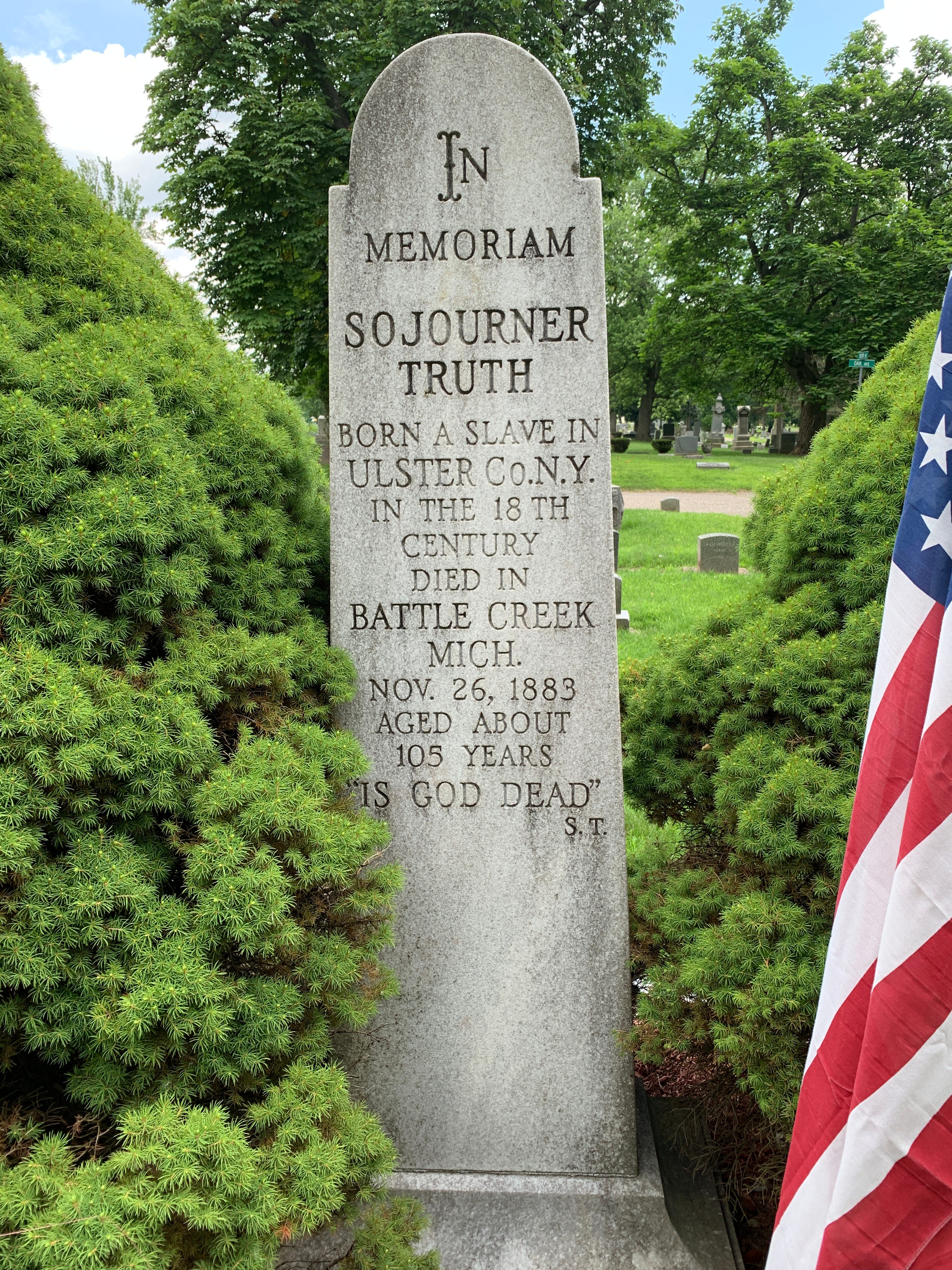
Born Isabella Baumfree, she was later known as Isabella Van Wagenen, after a family who took her in when she “walked away” from slavery at the age of 29.
In 1843, at age 46, Isabella Van Wagenen had a divinely inspired vision. She renamed herself Sojourner Truth, left New York City, and set forth on her life’s work of “testifying of the hope that was in her.
https://www.nationalabolitionhalloffameandmuseum.org/sojourner-truth.html
So, what did Truth really say at the Akron Woman’s Rights Convention and how do we know? Of course, there were no audio recordings of her speech. However, her journalist friend, Marius Robinson, an editor of The Anti-Slavery Bugle and one of the convention’s secretaries, published the earliest substantial account of Truth’s remarks several weeks later. The Sojourner Truth Project reports that Robinson and Truth reviewed his account before it was published. That makes it more credible than Gage’s version, although it cannot be considered a verbatim transcript.
Frances Gage was also at the convention in Akron, and, in fact, presided over the convention at which Truth spoke. By giving Truth a stereotyped Southern Black dialect in an account published the New York Independent on April 23, 1863—twelve years later—Gage created a version that historians now regard as unreliable.
Historian Nell Irvin Painter, who wrote a definitive biography of Sojourner Truth, Sojourner Truth: A Life, A Symbol, asserts that Truth almost certainly never said the famous line “Ain’t I a Woman?” (or “Ar’n’t I a woman?”). Painter argues that Gage’s version, published twelve years after the speech, transformed Truth into a stereotyped “colorful force of nature” and was written partly in response to Harriet Beecher Stowe’s romanticized—and factually unreliable—portrayal of Truth published earlier that month.
Gage’s account claims that Truth bore thirteen children and saw most of them sold into slavery. Historical accounts identify five children, another indication that Gage’s version is unreliable.
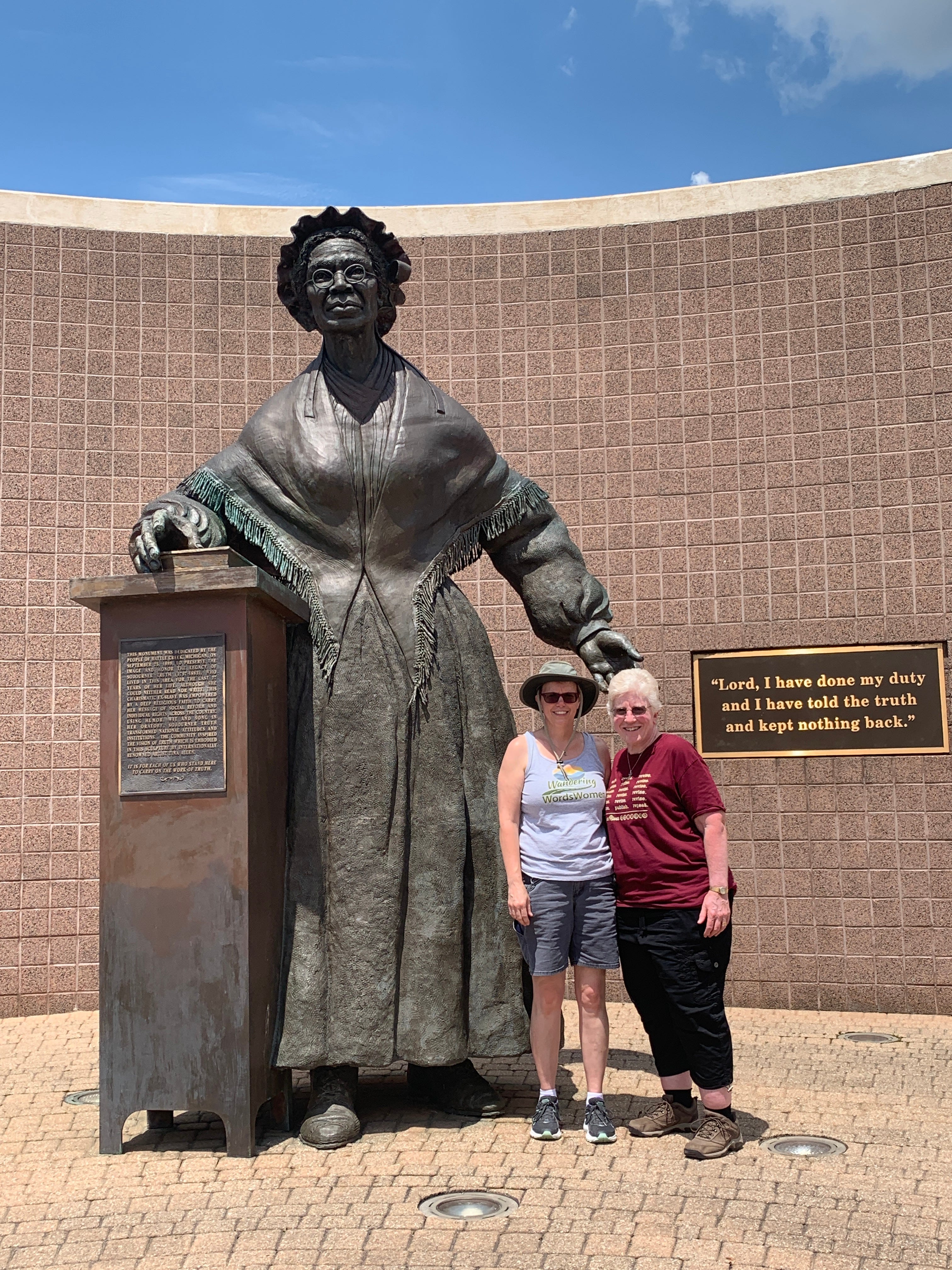
What do you think? Here are the two versions, published by The Sojourner Truth Project for you to compare:
Marius Robinson’s transcription: Published June 21, 1851, in The Anti-Slavery Bugle
May I say a few words? I want to say a few words about this matter.
I am a woman’s rights. I have as much muscle as any man, and can do as much work as any man. I have plowed and reaped and husked and chopped and mowed, and can any man do more than that? I have heard much about the sexes being equal; I can carry as much as any man, and can eat as much too, if I can get it. I am as strong as any man that is now.
As for intellect, all I can say is, if women have a pint and man a quart—why can’t she have her little pint full? You need not be afraid to give us our rights for fear we will take too much, for we can’t take more than our pint’ll hold. The poor men seem to be all in confusion, and don’t know what to do.
Why children, if you have woman’s rights, give it to her and you will feel better. You will have your own rights, and they won’t be so much trouble. I can’t read, but I can hear. I have heard the Bible and have learned that Eve caused man to sin. Well, if woman upset the world, do give her a chance to set it right side up again.
The Lady has spoken about Jesus, how he never spurned woman from him, and she was right.
When Lazarus died, Mary and Martha came to him with faith and love and besought him to raise their brother. And Jesus wept—and Lazarus came forth. And how came Jesus into the world? Through God who created him and woman who bore him. Man, where is your part?
But the women are coming up, blessed be God, and a few of the men are coming up with them. But man is in a tight place, the poor slave is on him, woman is coming on him, and he is surely between a hawk and a buzzard.
Frances Gage’s version: April 23, 1863, issue of the New York Independent
Well, chillen, whar dar’s so much racket dar must be som’ting out o’ kilter. I tink dat, ’twixt de niggers of de South and de women at de Norf, all a-talking ’bout rights, de white men will be in a fix pretty soon. But what’s all this here talking ’bout? Dat man ober dar say dat women needs to be helped into carriages, and lifted over ditches, and to have de best place eberywhar. Nobody eber helps me into carriages or ober mud-puddles, or gives me any best place. And ar’n’t I a woman?
Look at me. Look at my arm. I have plowed and planted and gathered into barns, and no man could head me—and ar’n’t I a woman? I could work as much and eat as much as a man, when I could get it, and bear de lash as well—and ar’n’t I a woman? I have borne thirteen chillen, and seen ’em mos’ all sold off into slavery, and when I cried out with a mother’s grief, none but Jesus heard—and ar’n’t I a woman?
Den dey talks ’bout dis ting in de head. What dis dey call it? “Intellect,” whispered someone near. Dat’s it, honey. What’s dat got to do with women’s rights or niggers’ rights? If my cup won’t hold but a pint and yourn holds a quart, wouldn’t ye be mean not to let me have my little half-measure full?
Den dat little man in black dar, he say women can’t have as much rights as man ’cause Christ wa’n’t a woman. Whar did your Christ come from? Whar did your Christ come from? From God and a woman. Man had nothing to do with him.
If de fust woman God ever made was strong enough to turn de world upside down all her one lone, all dese togeder ought to be able to turn it back and git it right side up again, and now dey is asking to, de men better let ’em. Bleeged to ye for hearin’ on me, and now ole Sojourner ha’n’t got nothin’ more to say.
Truth and Gender
In what is probably the more accurate version of her speech, Truth dismantled conventional ideas about what women could do and what they deserved. Drawing on her experience as a formerly enslaved Black woman, she challenged both sexism and the narrow definition of womanhood that excluded women like her.
Recovering her actual words matters. Gage may have helped turn Truth into an icon, but she did so by giving her a voice that was not her own. Honoring Sojourner Truth requires more than repeating a memorable slogan. It requires listening and interpreting what she said for today: women’s rights belong to women because they are human rights.
It’s a simple notion. We are all equal. Sojourner Truth knew that 175 years ago. And yet, it’s still a terrifying notion for so many. That struggle over who gets to define womanhood continues today, as people are still denied the freedom to understand and express their own gender.
On Women’s Equality Day, that remains a fitting charge—to defend every person’s right to be heard, to define themselves, and to participate fully in public life.
May you have a happy Women’s Equality Day. I pray that someday we can rest knowing our rights to express ourselves, no matter who we are, are secure.
Yours in peace and beauty,
Annette

If you connect with this post, I’d love to hear from you. Every comment you leave and every time you share a post, you improve the visibility of this post for other Substack readers. So, for both reasons, your comments and shares are especially appreciated.
Annette’s Wanderings is a reader-supported publication. All my posts are free for everyone. But even though I don’t put up paywalls, a paid subscription goes a long way to helping to support my writing. Please consider becoming a monthly or yearly paid subscriber. If you’re one already, you have my undying gratitude! Thank you for all your support!
Thanks for making the truth known…as usual!
Well, I did NOT know that about the popularized Gage version of Sojourner Truth's speech. Fascinating.